Project management is an essential but often overlooked aspect of any endeavor that involves producing high-quality work in a measured timeframe. Despite most people not giving it a second thought, some experts have dedicated their lives to understanding how we can manage projects better and proving just how necessary the field is. There are also different approaches to project management that use various theories in an attempt to be more effective. While there is no overarching correct answer, other theories can be better or worse for different projects depending on the parameters involved.
One such example is the agile software development method. As the name suggests, this method was originally intended to assist in the development of software, but the general principles can be applied to anything. It focuses on individuals and interactions, working software, customer collaboration, and responding to change. It also acknowledges processes and tools, comprehensive documentation, contract negotiation, and following a plan. While both sets of values are essential, the former are prioritized.
In addition to this, agile software development also includes a list of thirteen principles. These include but are not limited to welcome changing requirements, even in late development, face-to-face conversation as the premier form of communication, and continuous attention to technical excellence and sound design. While the whole set of principles touches on many more topics, they all have the same focus; producing high-quality products that leave the user as satisfied as possible.
A very similar project management technique is design thinking. I have used this strategy many times for many projects but never thought of it as project management until analyzing it closer. There are five steps in the design thinking process: empathize, define, ideate, prototype, and test. Each of these helps make the problem evident and lays out various ways to be solved. The most vital thing to note about the design thinking process is that it is non-linear so that each step can be revisited at any time. In the context of graphic design, creating such a clear understanding of the task at hand is vital to success.
Another method of project management is Kanban. Developed by Taiichi Ohno, an industrial engineer for Toyota, this method is popular in both warehouse settings and personal use. It centers around using a tracking system to prevent the buildup of extra inventory in the production line. Kanban uses six rules which are as follows:
- Each process issues requests (Kanban) to its suppliers when it consumes its supplies
- Each process produces according to the quantity and sequence of incoming requests
- No items are made or transported without request
- The request associated with an item is always attached to it
- Processes must not send out defective items, to ensure that the finished products will be defect free
- Limiting the number of pending requests makes the process more sensitive and reveals ineffectiveness
While it may be difficult to understand how this process can be applied to non-industrial processes, it can be very effective. The most widely applicable part of this process is the card system that is used for tracking. It is mentioned in the rules that “the request associated with an item is always attached to it.” This step makes sure every detail is being tracked and that nothing can be forgotten.
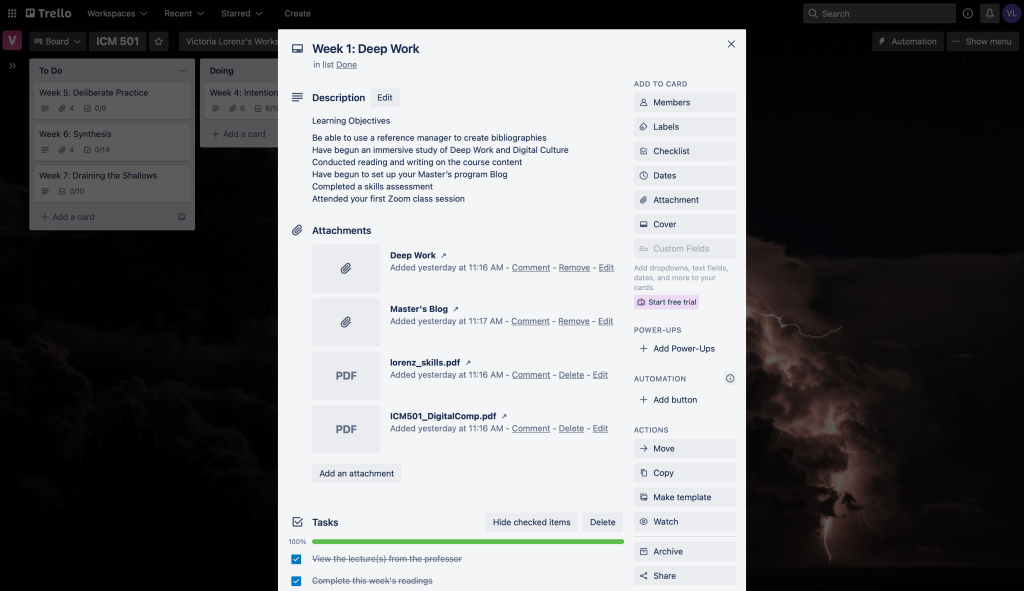
I tested this method by tracking my academic work through the project management system Trello. Trello is set up to allow the user to create three categories of cards: done, doing, and to do. In each category, cards are created that contain more information about the associated task. By default, space is left for a description, but beyond that, the contents are entirely customizable. You can invite other members, add labels, create checklists, associate dates, attach external resources and information, and even add a cover image.
Having so many options was daunting at first, but I was pleased with how adaptable the process was after some experimenting. I tend to be highly organized but gravitate toward a paper planner rather than digital systems because they never encompass all of the resources I desire. I enjoyed working with Trello because I could set everything up in the way that made the most sense to me.
Something else that I appreciated was that by creating a card for each week of the course, I was forced to look ahead and understand the work that I would soon be faced with. I typically go week by week, which can create problems if one week has an unexpectedly heavier workload than another. Because I am so organized, I did not expect to find any benefits in this system, but it was very beneficial, to my surprise.
 Victoria Lorenz