
The most important part of being a UX/UI designer is understanding and empathizing with the user. It’s easier said than done because, as designers, we tend to get wrapped up in the technicalities and become so familiar with the interface that we forget not everyone has as much knowledge about it as we do. Steven Pinker refers to this concept as “the curse of knowledge,” and suggests trying to be more aware of your audience. UX/UI designers take this one step further by developing personas that create specific representations of fictional audience members.
The first step in developing personas is setting success metrics. Doing so guides you throughout development and lets you track the product after it launches to see its effectiveness with users. Once metrics are set, it can be helpful to segment the users and develop psychographic profiles. Segmentation creates subgroups based on demographics which helps with design because it is so specific. Psychographic profiles describe the attitudes and perceptions that these subgroups hold.
This knowledge about customers’ motivations (the why) makes it possible to create innovative solutions, products, ad campaigns, and customer support (the what) that cater to customers on a personal level.”
Kevin O’Connor, Personas: The Foundation of Great User Experience
Collecting this information allows us to develop fictional personas based on the intended audience. It’s essential to make personas feel real, so giving them photos, full names, and ages. Taking it one step further, writing out a day in their life can be extremely helpful because it forces you to think about small details that might otherwise be glossed over. In Personas: The Foundation of Great User Experience, Kevin O’Connor writes, “this knowledge about customers’ motivations (the why) makes it possible to create innovative solutions, products, ad campaigns, and customer support (the what) that cater to customers on a personal level.”
Creating personas can be challenging because it requires thinking about the life of someone with a different background than you. They’re likely a different age, from a different location, and have a different profession. O’Connor also notes that when more effort is put into personas, fewer redesigns are needed, benefiting both the users and designers.
Usability.gov suggests considering three main categories when developing personas: the vision for the site, a description of the user, and the users’ motivation. They also break down the description of the user into the categories personal, professional, and technical. Scrutinizing the specific is crucial because it leaves nothing up to chance.
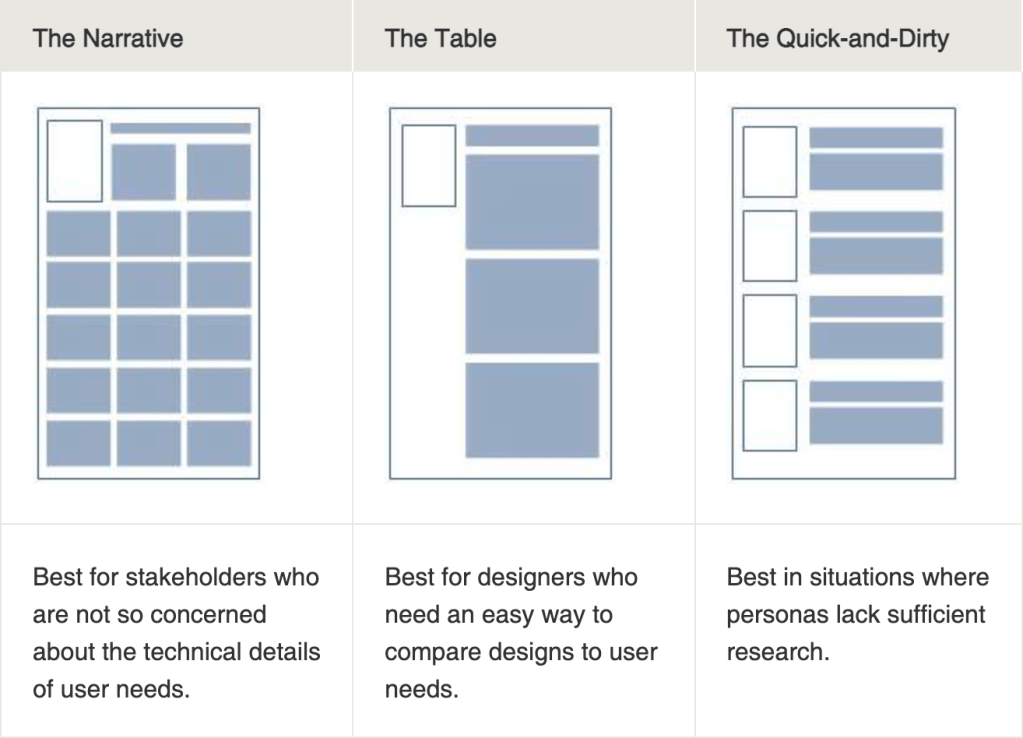
Dan Brown developed three main layouts to display personas tailored to different audiences. The first is “The Narrative,” which focuses on a grid system and is aimed at stakeholders who don’t need to want to know every detail. The following style is “The Table,” which gives more detail on the user, making it best for designers so they can quickly compare the design to user needs. The final form is “The Quick-and-Dirty,” which contains minimal information and is best when there is little research to accompany personas.
Developing personas may seem silly at first, but it is an excellent approach to ensuring positive user experiences. Taking more time at the beginning of a project to consider user needs will save frustration from all parties in the future.
 Victoria Lorenz