Pentagram is a design studio founded in 1972 that is multi-disciplinary and independently owned. They have 23 partners, some of whom work collaboratively and some independently. This studio is unique because the designers are also the owners and primary contacts for clients.
Being 50 years old, Pentagram existed for nearly a decade before the internet was invented. Now, it is almost impossible to be a design studio without involvement with the internet. Even studios that do not offer web design still have websites and social media pages.
Social Media and Graphic Design
Websites and social media are crucial for design studios and independent designers alike. At this point, websites are expected and serve as a place to showcase projects. Social media is taking a similar role in letting designers share their work, make professional connections, and share their knowledge.
Independent designers like myself often use social media to share their work for pleasure and as another resource for future employers to see our work and processes. Studios like Pentagram are more likely to use social media similarly as a reference for potential clients and to contribute to the design community as they are highly regarded.
Generally, they share images and videos about projects their partners are working on independently or with their clients. As such, they lack a singular aesthetic making their feed full of color and combining images, type, print collateral, package design, gifs, flat design, and more.

Posting such a wide variety of generally unrelated work may not work for many studios, but Pentagram curates their posts so that even though everything is different, it flows with ease.
Social Media Audit
Despite being founded before the internet was invented, Pentagram has a solid social media presence with Instagram, Twitter, LinkedIn, Facebook, and Pinterest accounts.
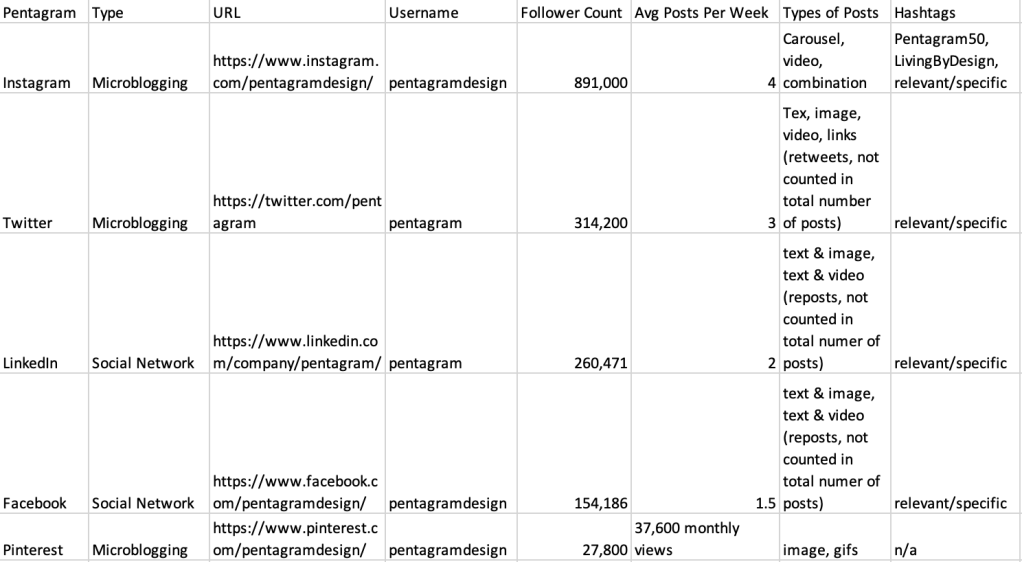
Of these, Instagram is the most successful. This trend makes sense as Instagram is traditionally a photo-sharing network. It is also prevalent among designers, so it is likely that of all the social media platforms available, it has the highest population of designers. Pentagram has 891k followers on Instagram and posts an average of four times a week. The only hashtag that regularly repeats in their media is “LivingByDesign.” All others are specific to the content, such as “Pentagram50,” which was used to celebrate the studio’s 50th anniversary. They primarily post videos, carousels of images, or a combination of the two.
The next most successful platform for Pentagram is Twitter, with 314.2k followers – less than half as many as on Instagram. While much of the content they post on Twitter is similar to that on Instagram, the ability to retweet is one difference that sets them apart. While Pentagram posts on Twitter an average of three times a week, they retweet an average of five times a week. This likely increases their overall engagement because it gives users more opportunities to interact with the account. It also encourages more clicks because retweets republish content from other accounts, allowing the curious designer to discover new peers, studios, and sources of inspiration.
Their third most successful platform is LinkedIn, with 260,471 followers and an average of two weekly posts. LinkedIn is very popular among individuals but less so for businesses. They primarily post images or videos accompanied by text and limit it to more significant announcements such as their 50th anniversary.
Facebook is the fourth best performing, with 154,184 followers and posting an average of 1.5 times a week. Like LinkedIn, they use Facebook to post images or videos accompanied by text to share more important announcements.
I was surprised that Pinterest was the least successful of the platforms they use, as it is extremely popular among designers for visual research. On Pinterest, they have 27.8k followers and are averaging 37.6k monthly views. It is challenging to assess the success of Pinterest without access to the account because posts do not have dates, and you can’t see how often something is pinned or liked. It is possible that despite having a low number of followers, the engagement rate with their content is high because Pinterest does not create your feed exclusively based on the accounts you follow, unlike other platforms.
Observations & Suggestions
After conducting this audit, I believe that Pentagram should maintain their current Instagram strategy and focus more on Twitter and Pinterest. While such a notable studio needs to have a presence on Facebook and LinkedIn, the nature of their content does not align with what is common for those platforms. Twitter should be important for Pentagram because it is often used to share and consume news. As leaders in design, Pentagram is often relied on for updates about design trends and notable projects. They also have a lot of potential on Pinterest because designers widely use it. To maximize their potential for success on Pinterest, they should consider broadening the kind of content they share to include tutorials or inside looks at the design process rather than only their finished projects.
Despite being successful, Pentagram has room for improvement with their social media presence. They could benefit from reassessing their audience and how different platforms are used within that demographic rather than posting slight variations of the same content on each.
Sources
Best Ways to Reap Benefits out of Instagram as a Graphic Design Professional
 Victoria Lorenz