
What Are Paid and Organic Social Media?
When looking at the differences between paid social media advertising and organic social posts, it is essential to understand what makes each unique. Paid social media advertising is content that a brand or company pays for their content to be pushed to their target audience. Organic content on social media does not use paid promotion and relies on content reaching its audience via their feed or being shared with them.
Both paid and organic content can be highly effective but is one better than the other? Ultimately, it depends on the company’s goals because they each serve different purposes.
Paid Social Media
One of the most common misconceptions about paid social media is that it costs a lot of money. This is not necessarily true – you can get started with paid social media advertising for less than $50. Much of the cost is determined by the kind of paid advertising you use.
Four of the primary forms of ad measurement, according to Dave Kerpen in Likeable Social Media, are cost per thousand impressions (CPM), cost per click (CPC), cost per action (CPA), and cost per view (CPV). Each caters to different goals and will result in different budget needs. For example, if you have a maximum budget of $50 for cost per view, your ad will only reach $50 worth of people, but if you use that same $50 budget for cost per click, many more people will likely see it because only a small portion of everyone who sees it will click on it.
Organic Social Media
It is often assumed that organic social media is free, and while it technically might be, it is vital to remember that someone needs to spend time creating it. For example, I worked as a social media assistant for Quinnipiac University’s marketing and communications department. I spent fifteen hours each week planning content and collecting the visual assets for the final product or, with the help of my manager, assigning other students to collect visual assets or create content. Much of the content I was responsible for was not paid content but ended up costing the department about $195 (my paycheck) each week.
Despite this somewhat hidden cost, organic content is still valuable. It has the benefit of reaching a portion of your target audience that you already have access to, allowing you to keep them engaged with your brand. Organic content also allows brands to be more personal and build community and brand loyalty among followers.
REI Cooperative Action Campaign
One example of a successful campaign is the REI’s Cooperative Action movement urging congress to pass the Outdoors for All Act. The act would require green spaces in underserved communities.
It is essential to acknowledge that part of what makes this campaign so successful is that it relates very strongly with REI’s brand values as an outdoor company. It proves that they care about their overarching mission and are willing to act on matters that won’t directly cause products to sell.
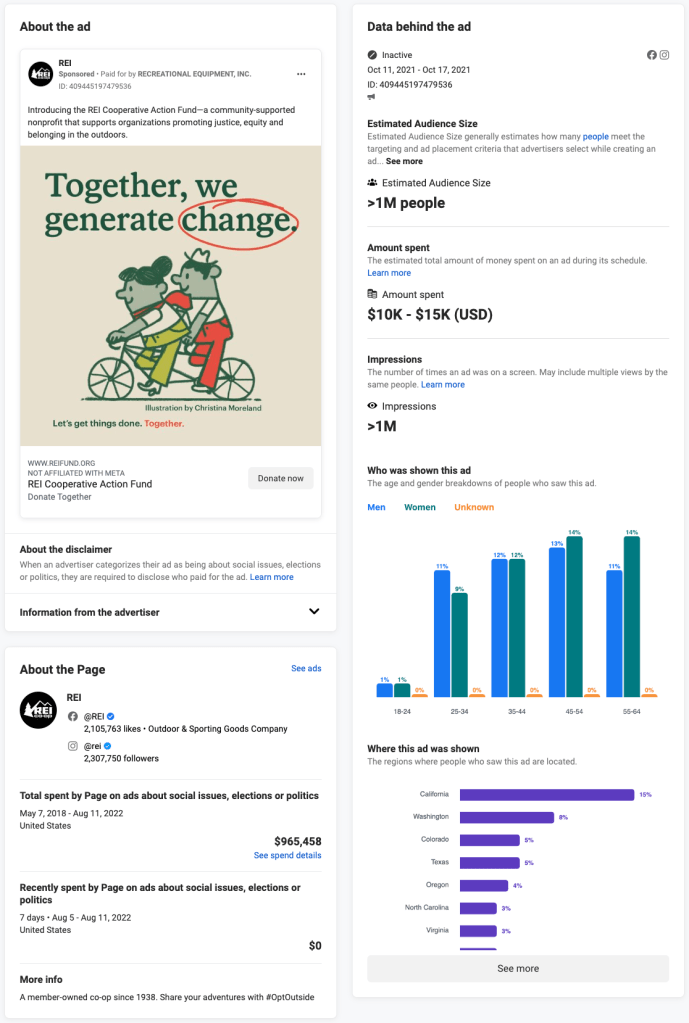
According to Meta Ad Library, REI launched eight ads on October 11th, 2022, on Instagram and Facebook about the Outdoors for All Act. Meta estimates that REI spent as little as $600 on some ads and $10,000 on others. The ad which cost an estimated $600, got 125,000 impressions and reached more men than women, focusing on Texas, California, and Florida. The ad which cost an estimated $10,000, got more than one million impressions and reached slightly more women than men, focusing on California, Washington, and Colorado.
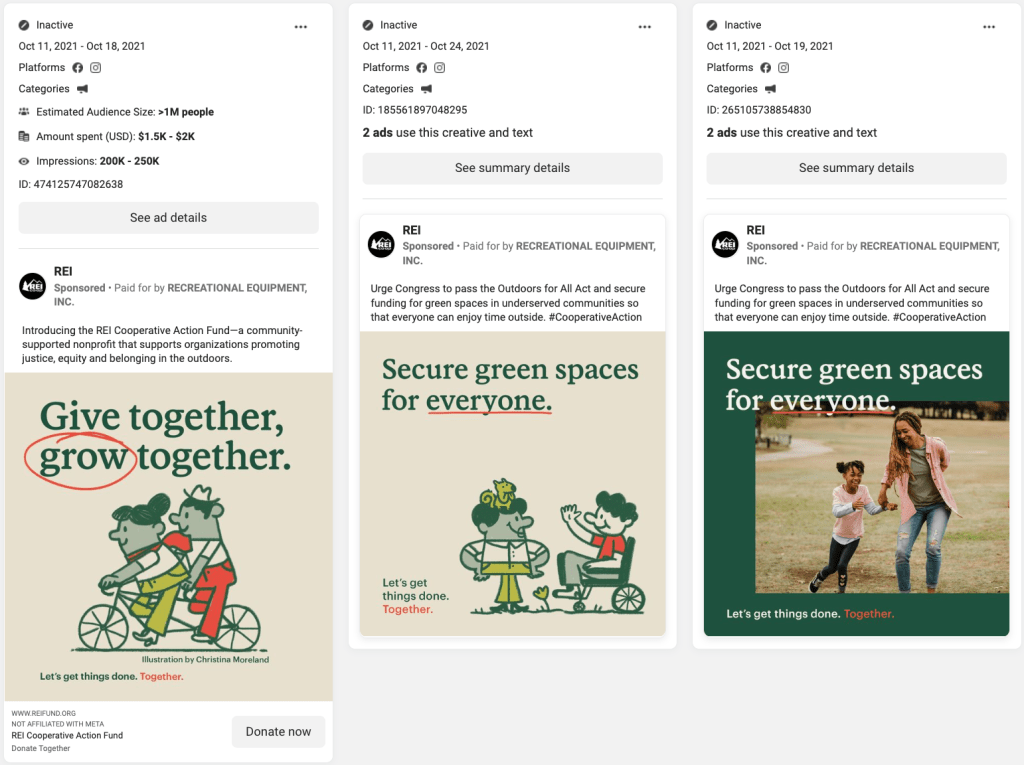
Four of the eight ads launched use copy that reads “Introducing the REI Cooperative Action Fund – a community-supported nonprofit that supports organizations promoting justice, equity, and belonging in the outdoors.” The other four say, “Urge Congress to pass the Outdoors for All Act and Secure funding for green spaces in underserved communities so that everyone can enjoy time outside. #CooperativeAction”. Both sets of copy are short and to the point but take different approaches to make their point. The first focuses on what REI is doing to make a difference while the second is a call to action for the audience to help.
By sharing their efforts while calling for action from their audience, REI created a sense of community while giving customers a reason for brand loyalty. Using the hashtag #CooperativeAction also provides the audience with a space to see like-minded people and join the conversation by sharing their thoughts and actions.
Dove Crown Act
Another example of a successful campaign is Dove’s Crown Act movement urging their audience to sign a petition to help pass the crown act banning hair discrimination.
According to Meta Ad Library, they launched three ads in 2022; one on July 18th, July 19th, and July 23rd, respectively. Each has different content and copy, but all focus on race-based hair discrimination and use the hashtags #TheCROWNAct and #HairDiscrimination. Each ad got more than one million impressions and primarily reached women in California and Texas. Meta Ad Library estimates that Dove spent $175,000 on the June 18th ad, $90,000 on the June 19th ad, and $90,000 on the 23rd ad.
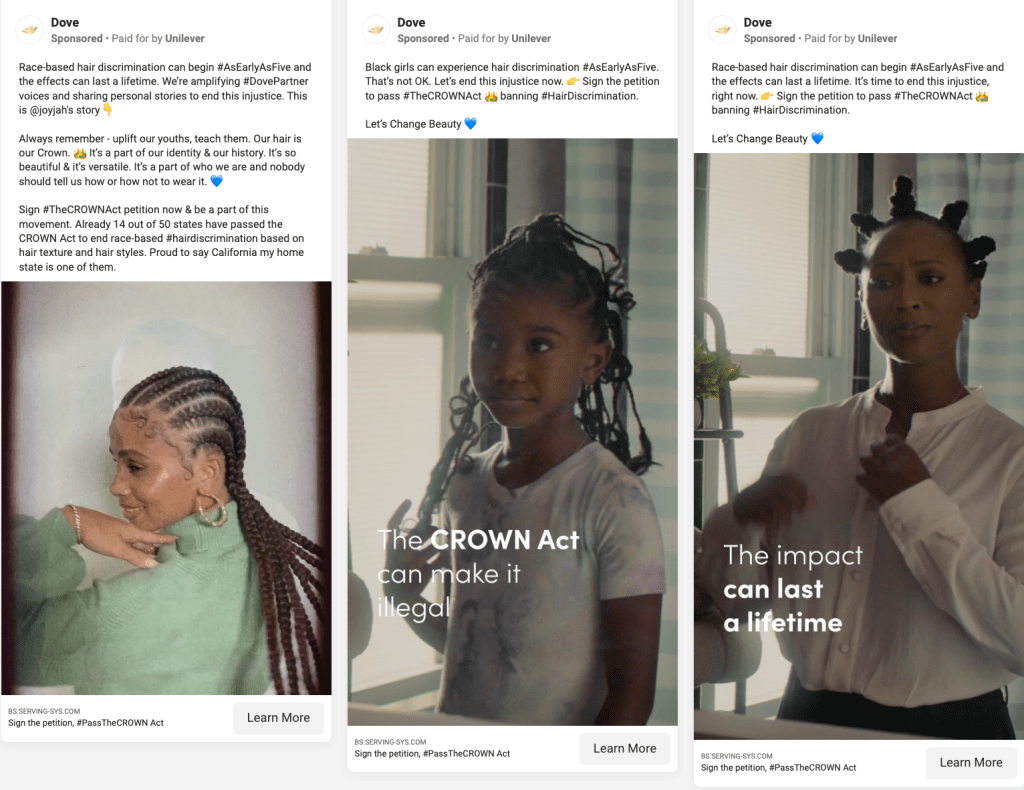
The copy of the June 18th ad reads, “Race-based hair discrimination can begin #AsEarlyAsFive and the effects can last a lifetime. It’s time to end this injustive, right now. *Pointing emoji* Sign the petition to pass #TheCROWNAct *Crown emoji* banning #HairDiscrimination. Let’s Change Beauty *blue heart emoji*”. The June 19th ad reads, “Black girls can experience hair discrimination #AsEarlyAsFive. That’s not OK. Let’s end this injustice now. *Pointing emoji* Sign the petition to pass #TheCROWNAct *Crown emoji* banning #HairDiscrimination. Let’s Change Beauty *blue heart emoji*”. The June 23rd ad reads, “Race-based hair discrimination can begin #AsEarlyAsFive and the effects can last a lifetime. We’re amplifying #DovePartner voices and sharing personal stories to end this injustice. This is @joyjah’s story *hand pointing down emoji* Always remember – uplift our youths, teach them. Our hair is our Crown. *Crown emoji* It’s a part of our identity & history. It’s so beautiful & versatile. It’s part of who we are and nobody should tell us how or how not to wear it. *blue heart emoji* Sign #TheCROWNAct petition now & be a part of this movement. Already 14 out of 50 states have passed the CROWN Act to end race-based #hairdiscrimination based on hair texture and hair styles. Proud to say California my home state is one of them.”
Each builds on the previous and ends the campaign with a powerful statement from one of their brand partners to make the campaign more personal. This approach builds brand loyalty and reputation by standing up for a cause that aligns with the brand value and does not directly promote their products. They also made the brand seem more personable by featuring a partner to whom the audience can relate.
Overall, both organizations are very different but have positive social goals, which they utilized their platforms to work toward. Aiding these efforts helps the companies look good while also giving the audience a reason to support the brand.
 Victoria Lorenz