
Positive user experience comes from understanding user needs. In this brief exercise, I interviewed one of my classmates, Connor, to get a better idea of his needs as a student in one of Quinnipiac’s graduate programs.
Define
We started by defining the problem and empathizing. This step was particularly interesting because Connor and I have many similarities, such as being part of accelerated programs and participating in the undergraduate honors program, so I assumed we would have similar experiences and feedback. I soon learned that our unique experiences led to different opinions and feedback.
Empathy
When interviewing Connor, I learned that he found the graduate program very different from undergraduate. One crucial difference he and I have is our undergraduate majors; he was advertising, and mine was graphic design. Connor also told me that he feels isolated from his graduate program peers.
After our initial interview, I asked him to elaborate on the differences he is experiencing in workload and peer connection. He described the weekly blog posts as a never-ending academic death march that yielded limited benefits for him. I have found that many students, including myself, feel similarly about these assignments. Connor noted that he prefers when a course ebbs and flows.
Needs and Insights
Connor also told me that he was heavily involved in clubs and student organizations as an undergraduate student and now feels like he has been severed from campus as a remote graduate student. He chose to live off campus because it made more sense for him, but he was surprised by the different ways to stay involved and in touch. After researching, I found that Quinnipiac has nearly 140 undergraduate student organizations and only ten graduate organizations. Additionally, nine graduate organizations are highly specialized, leaving students like Connor only one option.
Defining the Problem
Once I had gathered this information, I defined the problem using the formula “___ is an issue for ____ because ____.” The statement I came up with says, “Feeling isolated is an issue for Connor because online classes have little to no peer support due to their structure.” It is important to note that in this instance, Connor represents many graduate students, especially those who are part of Quinnipiac’s accelerated programs or have recently completed their undergraduate degrees.
How Might We
Next, I wrote a “how might we” statement. This goal helps to rephrase the problem in a way geared toward generating solutions for the user. The statement I came up with says, “How might we create more opportunities for genuine peer connection and interaction in remote programs.” This approach focuses on encouraging emotional and academic support through peer-to-peer connections.
Ideate
Focusing on the defined problem and “how might we” statement, I ideated potential solutions. I drew inspiration from experiences I have had and commonly offered solutions. Some ideas I generated include social media groups, an internal network like Microsoft Yammer, casual weekly video calls, joint programs with other universities to provide on-ground experiences, and a graduate student retreat weekend on Quinnipiac’s campus.

I decided to focus on the casual weekly video calls, an internal network on a platform like Microsoft Yammer, and graduate student retreat weekend on Quinnipiac’s campus. I briefly sketched what these may look like and then presented the sketches with a verbal explanation to Connor.
Decide
Feedback
When I finished presenting the ideas, Connor gave me feedback on each. He liked the Facebook style structure because it reminded him of groups he joined before his first year of undergrad to meet people. He liked the idea of an internal network because it was not extra work and would make it easy to sort students into groups by school and program.
Reflect and Ideate
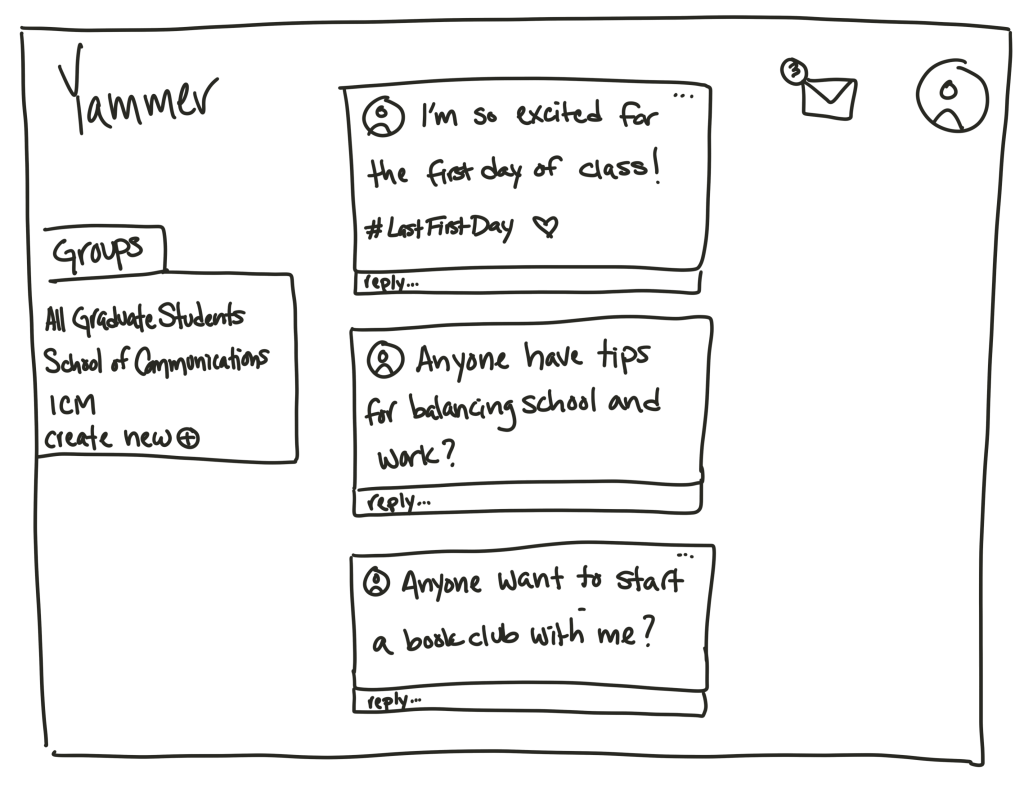
After hearing this feedback, I reflected on what I presented and looked for more ways to improve. I added a feature where students could create their own groups and made sure to include the ability to send direct messages.
Prototype
With this in mind, I redrew my original sketch at a slightly higher quality with more details and presented the updated solution to Connor.
Test
We gathered some final feedback on what worked and what could be improved. Connor liked that he could use Yammer to interact informally with peers, the increased opportunities to meet new people, not having to create a new account, and the ability to create groups.
Connor also had some suggestions for what could be improved. He wanted to integrate virtual events into the platform so students could synchronously meet. He also suggested having polls on Yammer to gather feedback on what graduate students want. My favorite of his ideas was for the university to release weekly prompts to spark conversation among students.
 Victoria Lorenz