
About personas
User personas are “archetypical users whose goals and characteristics represent the needs of a larger group of users,” says Patrick Faller from Adobe. It’s also important to note that while personas rely on archetypes, they represent a specific person with specific needs. Doing so prevents designers from making generic products and features.
Personas provide designers with a purpose when making decisions. It is easy to think about what people, in general, might like, but it becomes a lot harder when you have to think about one particular person. Think of it as the difference between buying a toy for the local toy drive and buying a toy for your niece Sarah who’s going through a horse phase.
Persona Notepad
Creating a persona can seem intimidating without the proper resources or structure. Using a persona notepad helps lay out the basics and ensures a strong foundation for the final personas. The persona notepad includes information from quotes and demographics to motivation and influences. Below are the persona notepads I made for Phillip and myself.
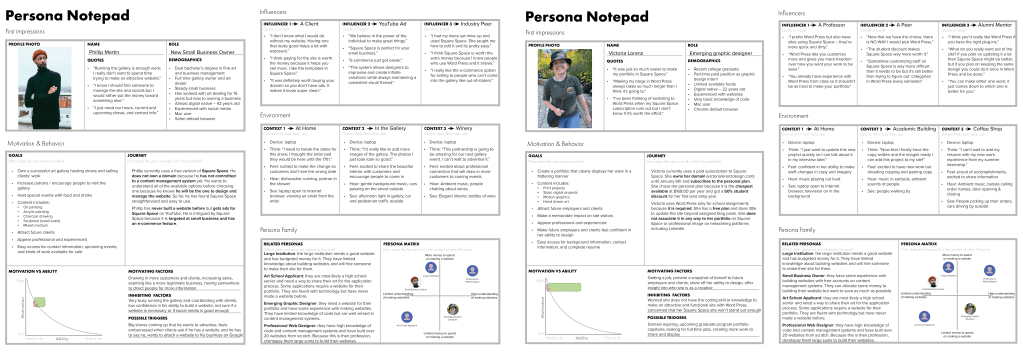
Validated & Hypothetical Personas
Let me introduce you to Victoria and Phillip to get a better idea of what personas are and why they are helpful. If you think the name Victoria sounds familiar, you’re right; it’s my name. Creating a persona based on a real person is called a validated persona. This article by Kevin O’Connor of UX Magazine explains that validated personas are created using information from research.
Validated personas often distill trends that are common among a group of users into a single fictional person. Because I don’t have access to data like this, I used inherent knowledge about myself and my experiences.
Phillip is a hypothetical persona. Rather than being based on real experiences, his information consists of what I expect another user might be like. Both personas are users of Square Space but have different backgrounds and experiences that make them unique.
Who is Phillip Martin?

Quotes
“Running the gallery is enough work; I really don’t want to spend time trying to make an attractive website.”
“I know I should hire someone to manage the site and socials but I would rather put the money toward something else.”
“I just need our hours, current and upcoming shows, and contact info.”
These quotes are things we can expect that Phillip would say.
Demographics
Phillip has two bachelor’s degrees, one in fine art and another in business management. He has used them to become a fulltime gallery owner and art dealer. His business is small but steady and is supported by 15 years of experience in the field. Although Phillip has never owned a business before, he is highly familiar with selling art because he used to work in a gallery.
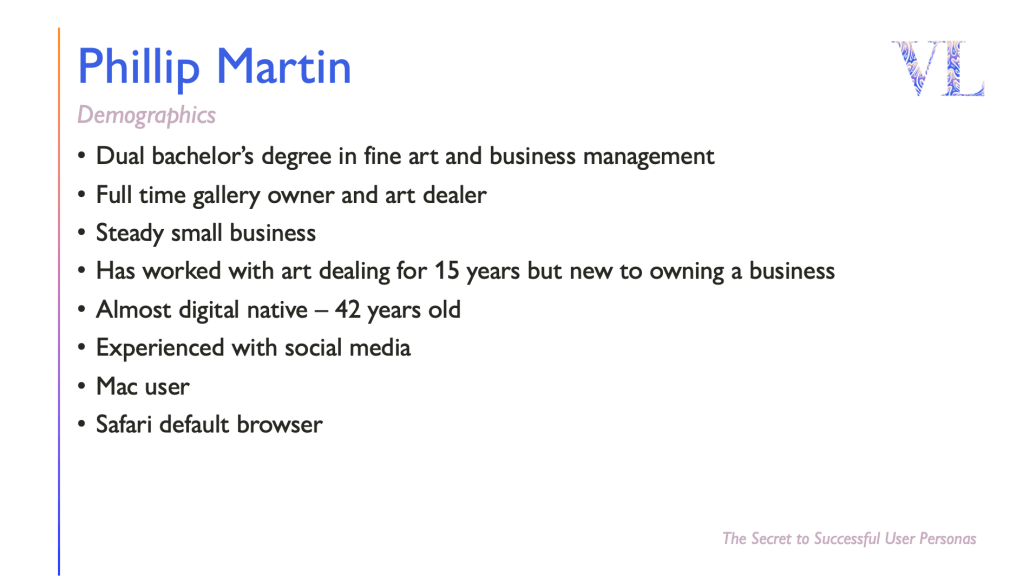
Phillip is 42 years old, and although he is not considered a digital native, he is fluent in technology, including the latest devices and social media. He uses a MacBook with Safari as his default browser.
Goals
Phillip’s primary goal is to own a successful art gallery that hosts shows and sells clients’ work. To get to this point, he wants to find ways to encourage people to visit the gallery, including hosting special events with food and drinks. He also wants to find ways to attract future clients. Phillip knows that the best way to do this is to make information such as contact information, upcoming events, and available work about his gallery easy to find.
Journey
A persona’s journey explores how they currently solve the problem. Phillip has a free subscription to Square Space and does not own his domain name. He wants to explore all of his website options before committing to one because they can be expensive, and he does not want to waste any money that could otherwise go into the gallery.
Motivation vs. Ability
Phillip has a reasonably high motivation for launching a website. He wants to draw in more customers and clients, increase sales, and have somewhere to direct people to find more information about his gallery. Phillip also knows that having a good website makes businesses seem more legitimate and creditable.
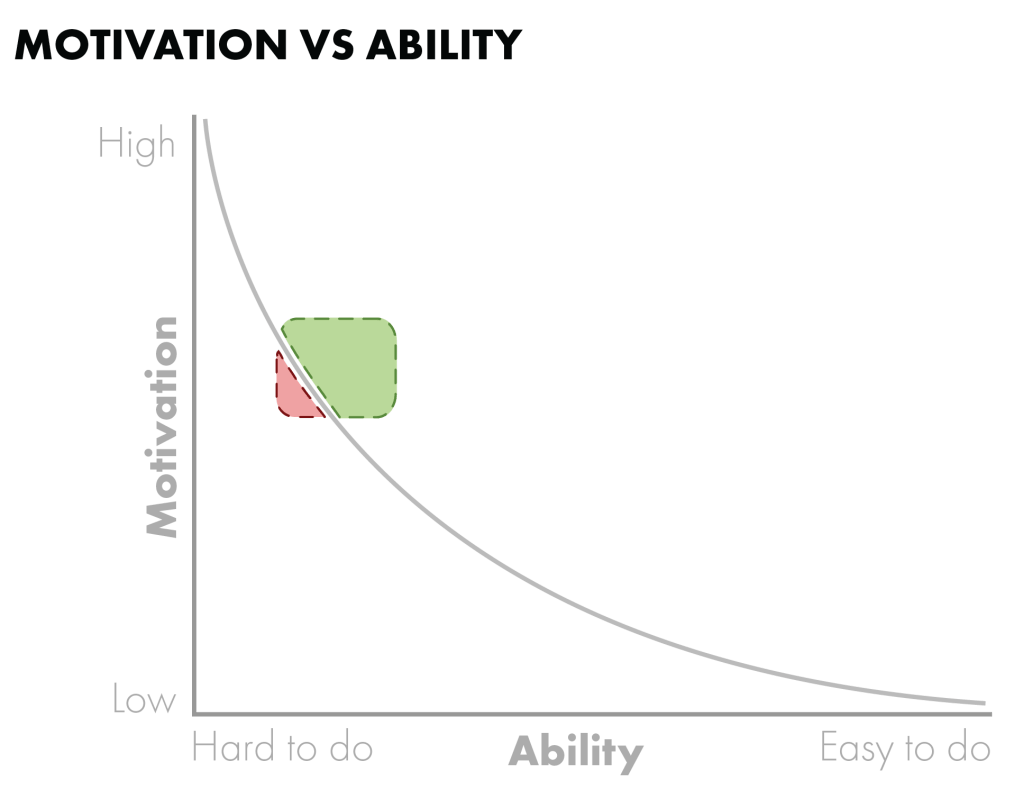
Some factors inhibit Phillip from launching his website. He is swamped running the gallery and coordinating with clients. He also often wonders if a website is worth his time and money when he can promote his gallery on social media.
Many things can trigger Phillip to launch his website. He may have big shows coming up that he wants to advertise. He may have meetings with potential clients coming up and will feel embarrassed if he does not have somewhere to direct them for more information. He wants to attach a website to his business on Google so that people can learn more about it when they see it pop up on the map. Phillip is also running out of time on his 14-day trial and will need to purchase a plan soon or choose a new content management system.
Influencers
Influencers are the people or things that impact the user’s decisions. Phillip has three influencers that we are focusing on. The first is an old, trusted client. They have been working together for ten years and have developed a strong friendship during that time.
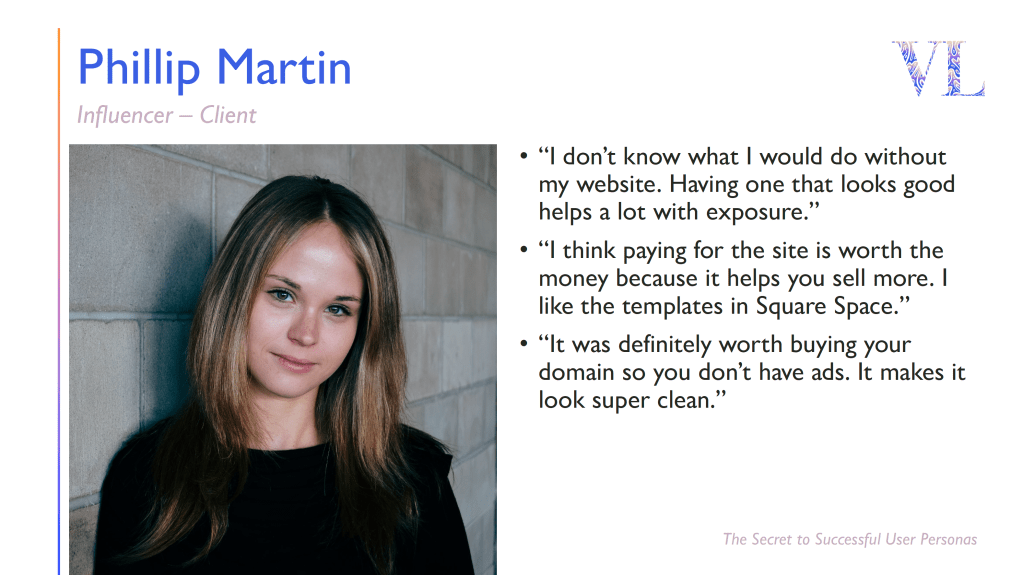
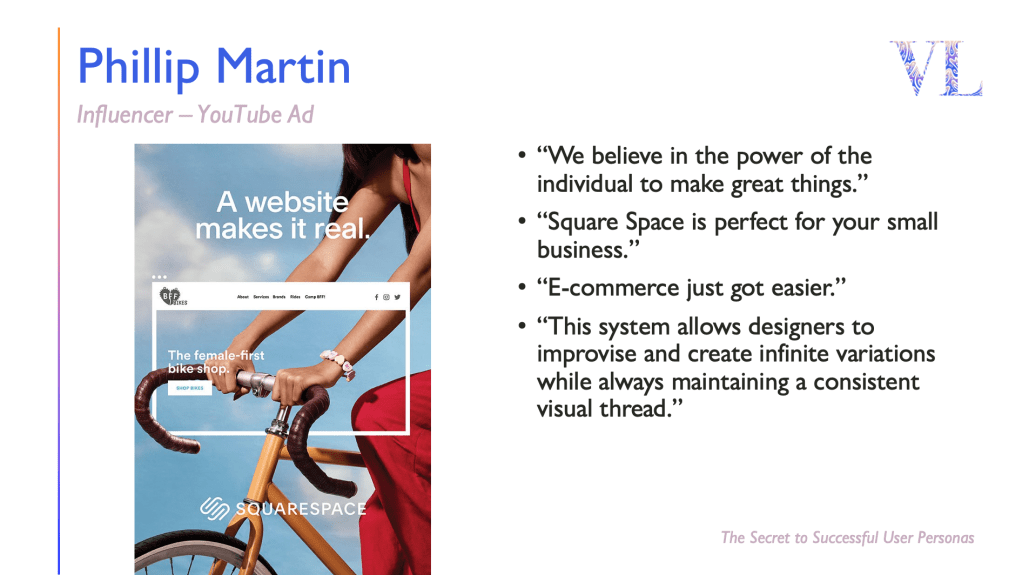
The next is a YouTube ad from Square Space. While this is not a person, the ads are made to feel highly personal and have significantly impacted Phillip.
The third influencer is an industry peer who has owned a gallery for 12 years and has used Square Space for eight years.
Environments
It is crucial to consider the different environments in which a person may use a product or service. Doing so gives us insight into the problems they might run into in other circumstances and makes us think more critically about how the user is interacting with it.
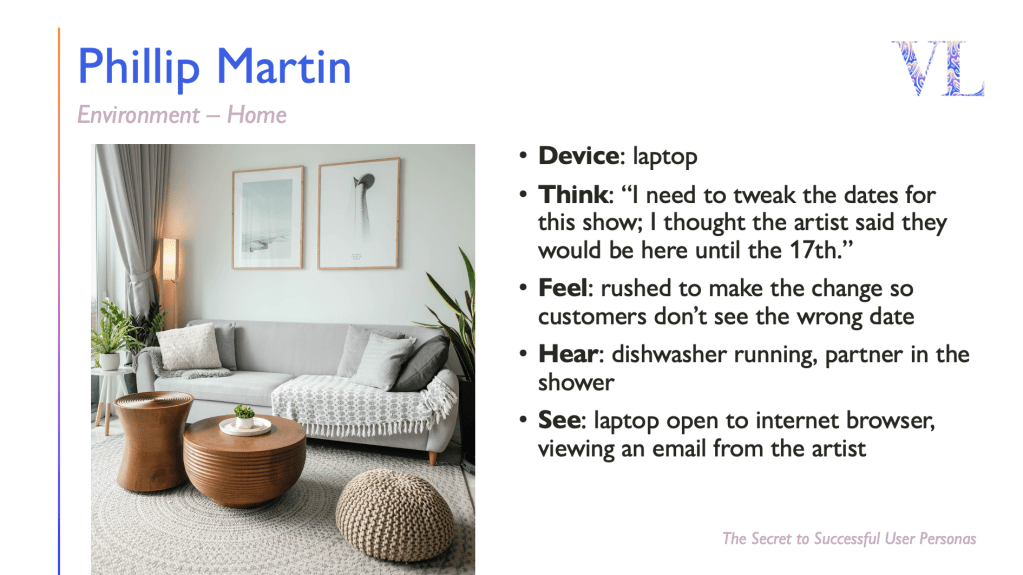
The first environment that Phillip uses Square Space in is his home. He is using it on his laptop and thinking about edits he needs to make to the site. He is feeling rushed to make the changes because he wants his patrons to be well informed. He hears the dishwasher running in the background and sees his laptop open in front of him on the kitchen table.
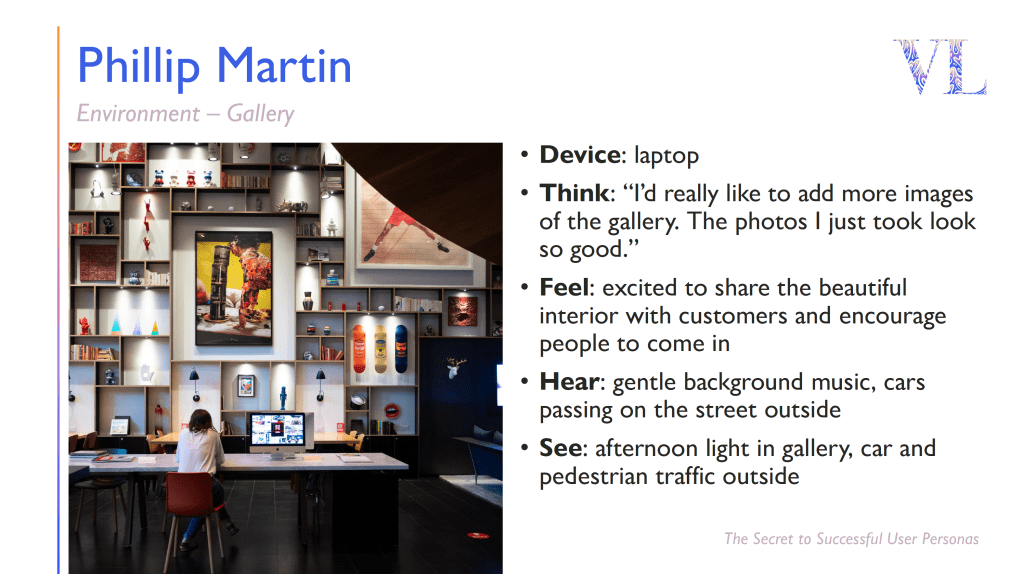
The following context is in the gallery. Phillip is working from his laptop and realizes that the gallery is beautiful in the afternoon light. He takes some photos and wants to upload them to his site to draw in more customers. He feels excited to share the beauty with clients and patrons and hopeful that more people will come in. He hears gentle background music and sees the afternoon light in the gallery with cars and pedestrians passing outside.
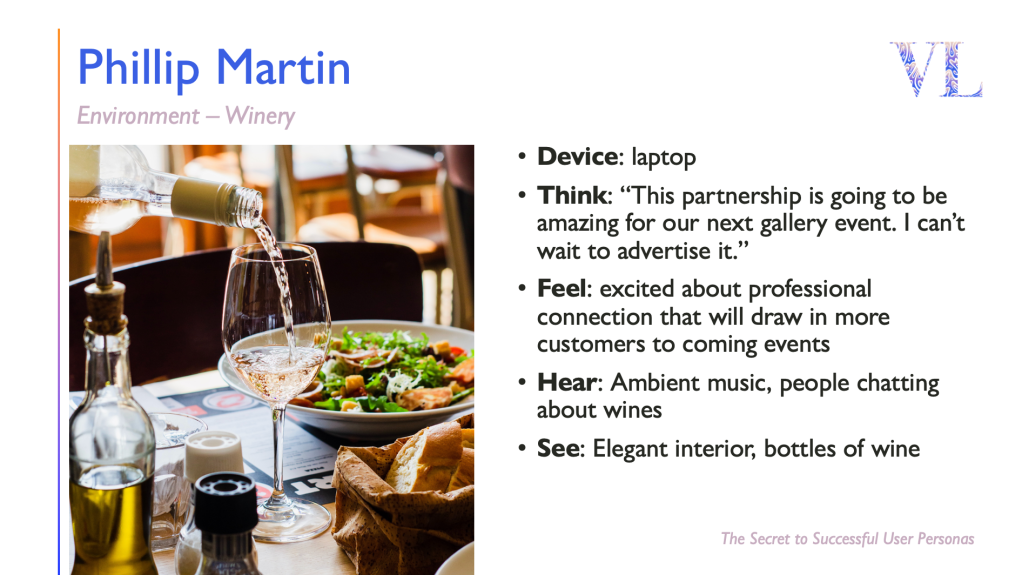
The final environment that Phillip uses Square Space in is a winery. He has reached out to a local winery inquiring about making a deal on some wine for an upcoming event at his gallery. He is feeling excited about this new professional connection and hopeful that they will make a deal with him. He relies on his website to provide information about his gallery and ensure the winery management that he is reputable. He hears ambient music and people talking in the background and sees the beautiful interior with many bottles of wine.
Who is Victoria Lorenz?

Quotes
“It was just so much easier to make my portfolio in Square Space.”
“Making my blogs in Word Press always takes so much longer than I think it’s going to.”
“I’ve been thinking of switching to Word Press when my Square Space subscription runs out but I don’t know if it’s worth the effort.”
These quotes are things we can expect that Victoria would say.
Demographics
Victoria is a recent college graduate pursuing her master’s degree while holding a part-time paid position as a graphic design intern. She has experience building websites using content management systems like Square Space, Word Press, and Go Daddy. She also has basic knowledge of code.
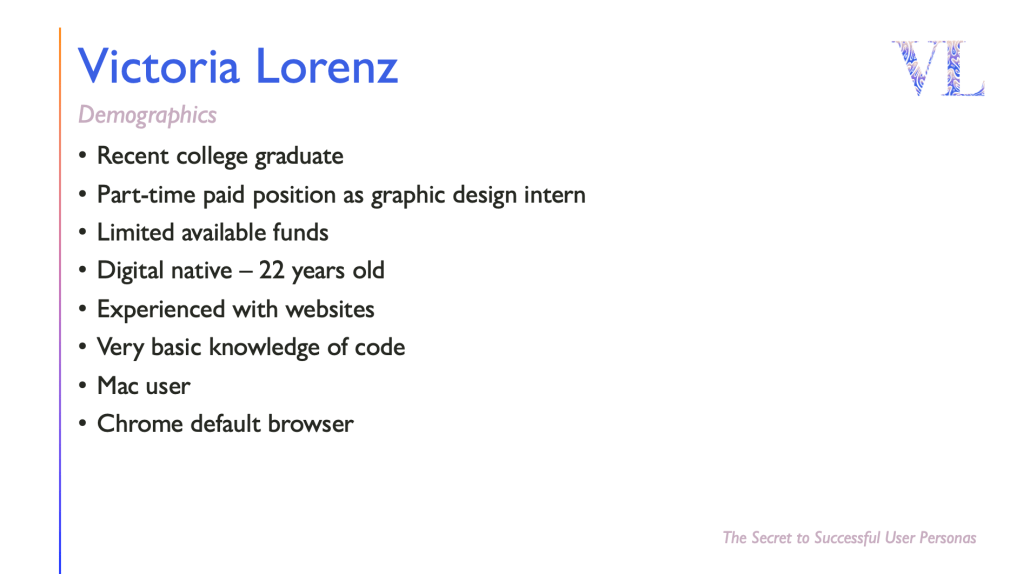
She is 22 years old and a digital native who is highly comfortable with current technology and social media. She uses a MacBook, and Chrome is her default browser.
Goals
Victoria’s goal is to create a portfolio that attractively displays her work. Her projects range from hand-drawn art to motion graphics. She wants to attract future employers and clients, make a memorable impact on site visitors, appear professional, and make prospective employers or clients feel confident in her ability to design. She also wants to make her background information, resume, and contact information easy to find.
Journey
Victoria solves this problem with a paid subscription to Square Space. She owns her domain (victorialorenzdesign.com) until January 6th when she must renew it. She subscribes to the personal plan because it is the cheapest available at $168 per year. She got a 50% student discount when she signed up, making it much more affordable.
While Victoria hosts her portfolio on Square Space, she uses Word Press for school assignments because it is required. She has a free plan and does little to update the site besides uploading the required blog posts. She does not associate the Word Press site with her portfolio because she does not like how it looks despite containing valuable content.
Motivation vs. Ability
The motivating factors for Victoria are getting a job, providing a snapshot of herself to future employers and clients, showing off her ability to design, and offering insight into who she is as a creative. She knows that having a solid portfolio is key to getting the jobs you want as a graphic designer.
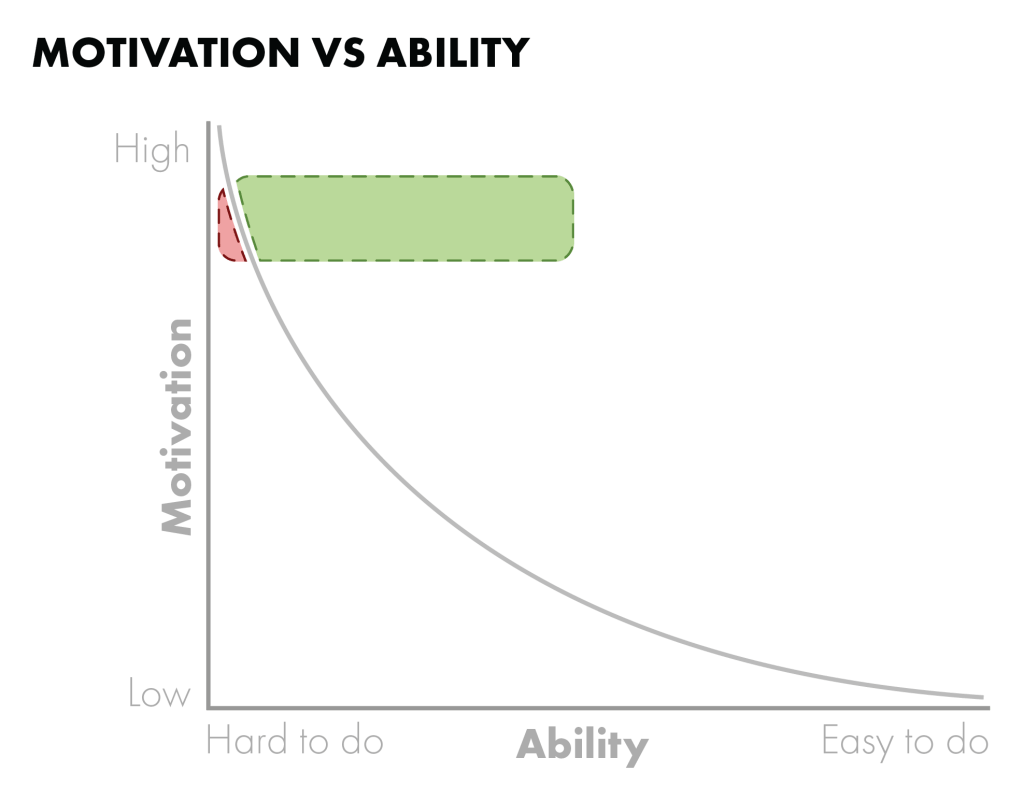
The inhibiting factors for Victoria include being concerned that her Square Space site won’t stand out enough because of the limited templates available and being too insecure in her knowledge of code to use Word Press. She sometimes wants to customize her Square Space site more but cannot because of the templates. She knows she would be able to make the changes in Word Press but is intimidated by how complicated it can get.
Triggering factors for Victoria include her domain and subscription needing to be renewed, the upcoming portfolio capstone course for her graduate program, looking for a full-time job, and creating more work to share and display. She knows she will be reassessing and likely redesigning her portfolio in the capstone course, which causes her to consider switching to Word Press for increased flexibility and customization.
Influencers
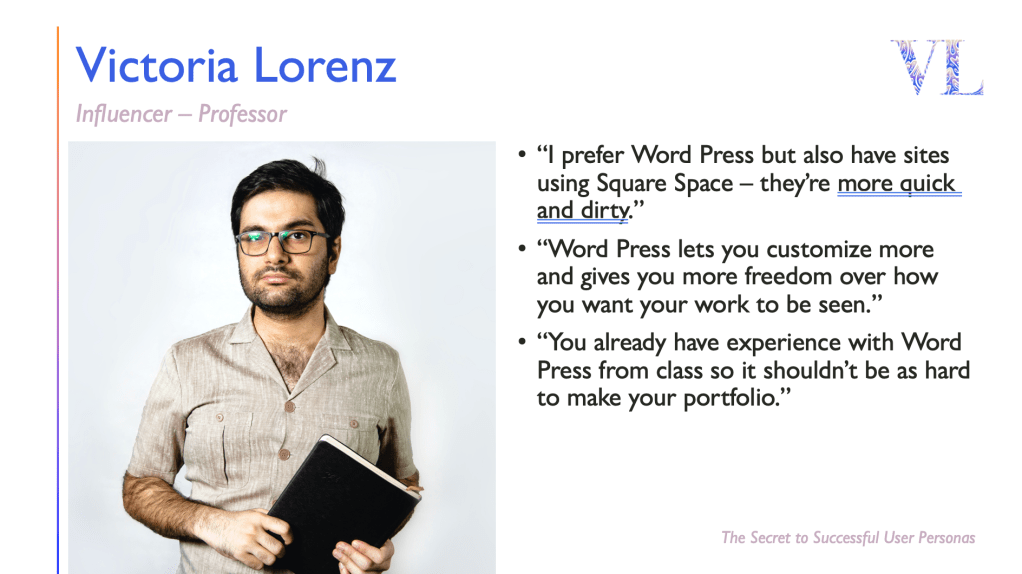
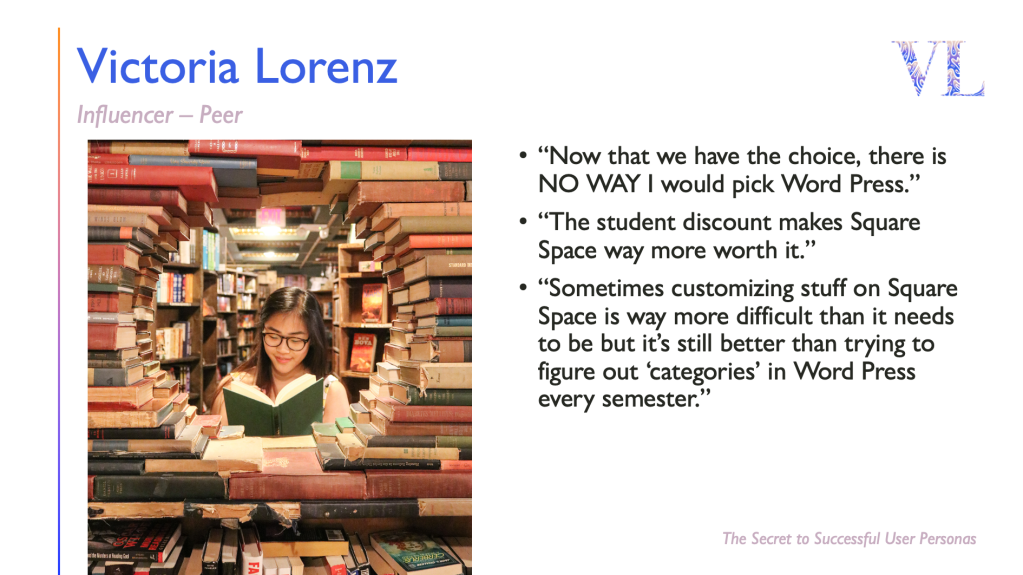
There are three primary influencers for Victoria. The first is a trusted professor from her undergraduate program. This professor has experience with creating portfolios and guiding students through the process.
The next influencer is a peer who majored in graphic design for their undergraduate degree and is doing the same graduate program. This student created their portfolio around the same time as Victoria and will also reassess it in the graduate capstone course.
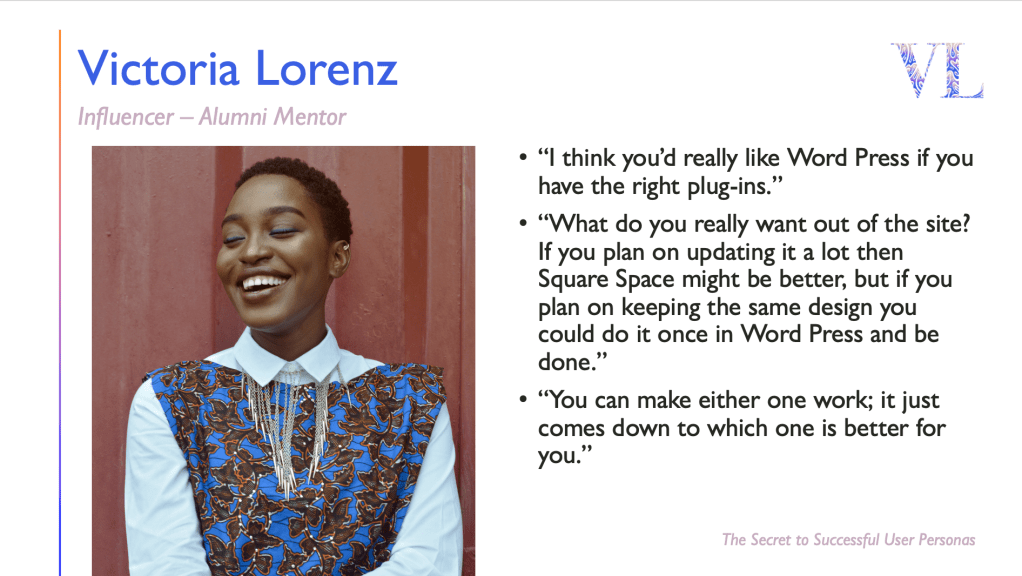
The final influencer is Victoria’s alumni mentor, who graduated from Quinnipiac, the university she attends, and is a professional web designer with his own business. She often turns to him for professional advice and assistance, especially in building her portfolio.
Environments
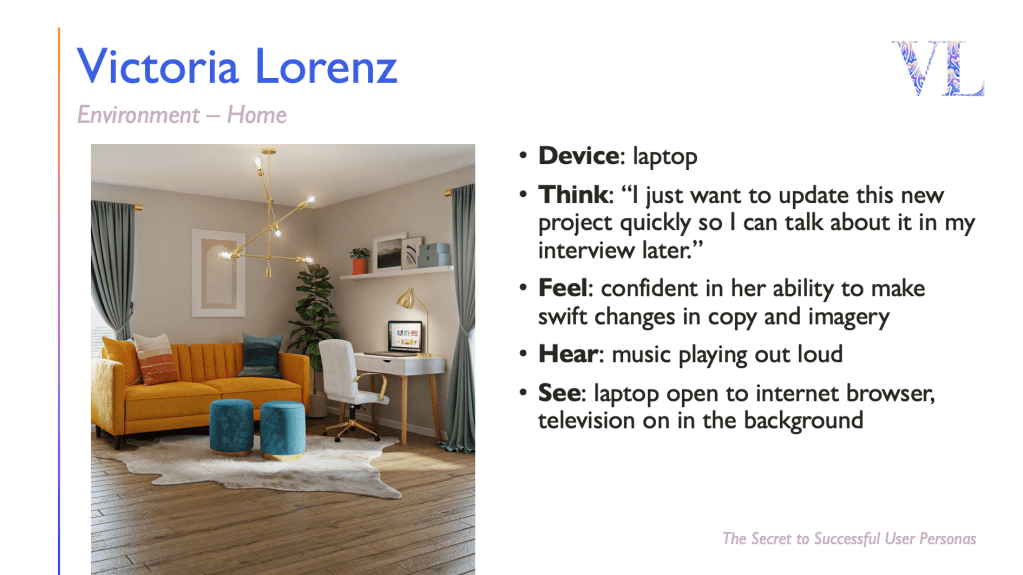
The first environment where Victoria uses Square Space is at home on her laptop. She wants to update a project she has been working on so she can discuss it later in an interview. She feels confident in her ability to make the changes and is excited to show off her work. She hears music playing aloud from her laptop and sees the television turned on to Spotify in the background.
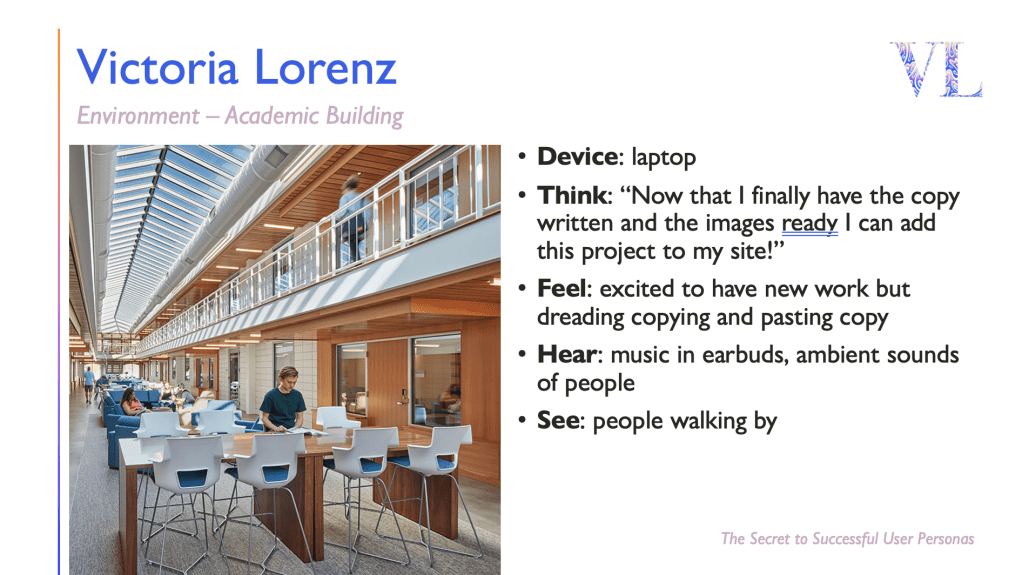
The second environment she uses Square Space in is an academic building on her laptop. Now that she has written out her process, she is ready to show the new project on her website. She is excited about having new work to display but dreads copying and pasting the text and uploading each image of her process. She hears music in her earbuds and sees people walking by.
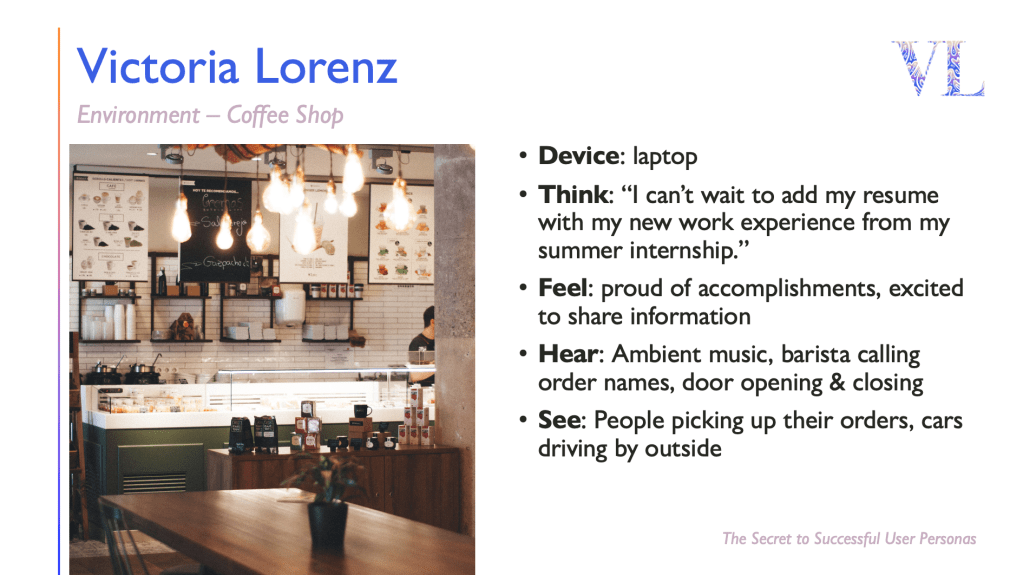
The third environment where Victoria accesses Square Space is in a coffee shop on her laptop. She is looking forward to adding her updated resume, which includes her summer internship. She is feeling proud of her accomplishments and excited to share the information with future employers and clients.
Related personas
The final step in understanding any persona is knowing how they fit into the related personas. Phillip and Victoria fall into this matrix alongside other user archetypes who do not have a persona. Phillip plays the role of a small business owner, and Victoria plays the role of an emerging graphic designer.
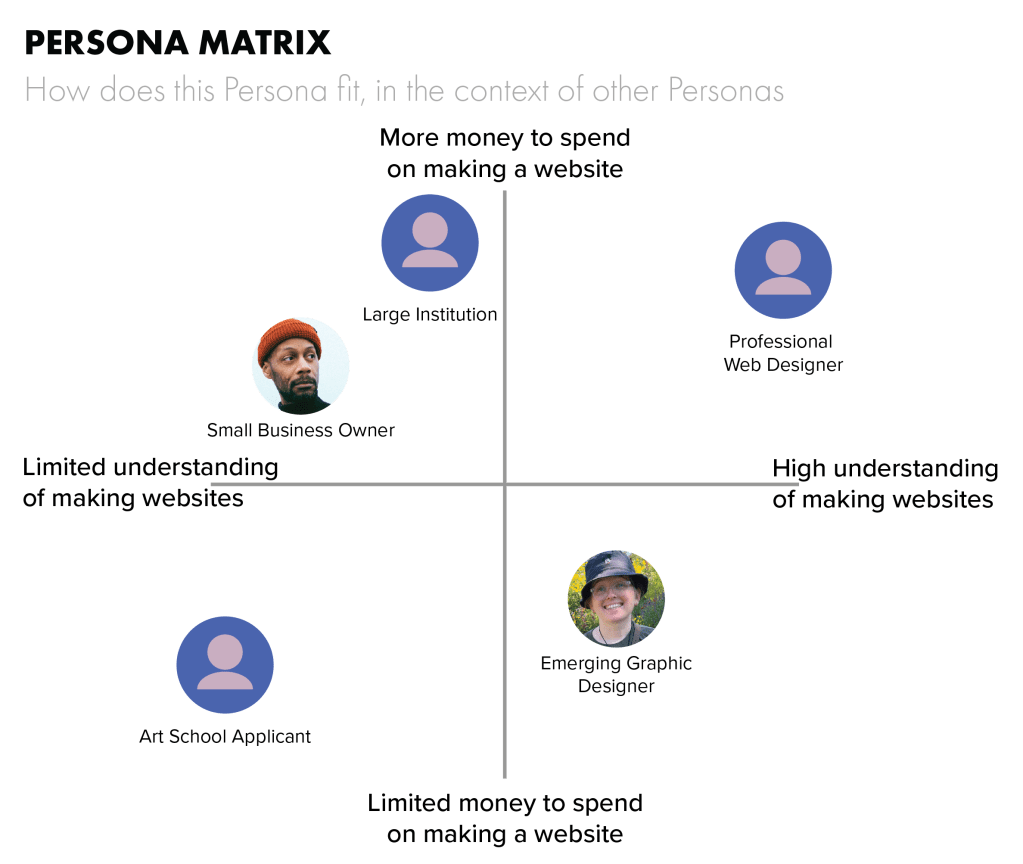
The other archetypes include a large institution, an art school applicant, and a professional web designer. The large institution needs an excellent website to represent them, and they have budgeted money to make it. The institution’s employees have limited knowledge about web design, so they will likely hire someone to make it for them.
The art school applicant is likely a high school senior with no experience building websites but needs somewhere to display their work for their applications. They are a digital native with a strong eye for design but will need to learn how content management systems work. They also need something cost-effective because they have only held part-time jobs and have limited money saved.
The last related persona is a professional web designer. They have a very high understanding of building websites with content management systems and code alone. Because this is their full-time job, they have more money to create sites because they can charge their clients accordingly. Most of the cost is for their time and talent rather than the cost of the domain or content management system subscription.
Insights
Creating user personas requires empathy. It forces designers to put themselves into someone else’s position and deeply consider all the different ways they might experience a product or service. Establishing this understanding gives every project a strong foundation and makes it less likely to require drastic changes down the road.
 Victoria Lorenz