Overview
In this module, I learned about the basics of sound and podcasting. After reading about both topics, I listened to podcasts and reflected on why I enjoyed them and what made them effective. Finally, I developed a mind map to help me begin planning my own podcast episode.
Reading & Writing
Basics of Sound
In chapter 8 of The Bare Bones Camera Course for Film and Video, Tom Schroppel describes audio in great detail. He defines sound and explains the ways it can be made and recorded.
Sound is made from waves that travel outward. Frequency is how close the waves are to each other and is measure in hertz (Hz). Amplitude is the size of the waves and is measured in decibels (dB). Microphones have diaphragms which function like human eardrums and vibrate, picking up sound, when waves reach it. Speakers work like vocal cords, vibrating to put out vibrations and creating sound.
Different kinds of microphones pick up different kinds of sound and have specific instance when each should be used. Lavalier microphones are small and often worn on the chest of the speaker. Because they are close to the speaker’s mouth, they provide a clear sound. Hand microphones are the most versatile and widely used in the industry. They can have different kinds of pickup patterns. Shotgun microphones are best for distant sounds because they only pickup sound from sources they are directly pointed at. Because shotgun microphones are used from a distance, they often pickup ambient noise which can be distracting.
Reverberation occurs when sound is reflected back and forth, getting quieter each time. When the sound fades to silence, it experiences decay. Ideally, a room will allow sound to decay smoothy and quickly. If it decays too fast it seems muffled and if it decays too slow it echoes.
Sound is best recorded close up. When recording sound for film or video, it is best to record synch effects once from afar with the scene then wild effects which are up-close. Similar to synch effects, synchsound is recorded at the same time that the camera is recording. Voice-overs are heard at the same time that video is seen but the narrator is not seen.
Basics of Podcasts
Now that we know how sound works, let’s explore podcast creation. The Podcast Host explains different ways to script podcasts and how to apply each method. Generally, scripts help ensure a podcast touches on all the intended points, makes it flow with ease, and cuts down on production time.
The goal of all podcast scripts, regardless of the style, is to be invisible. Invisible scripts make the listener think the episode is ad-libbed which keeps them engaged. The best way to create an script like this is to create a narrative flow by planning out the episode.
One type of script is word-by-word which is read by the podcaster exactly as its written. This style can be helpful when presenting something with a lot of detail or statistics but can sound very monotone and flat if the podcaster does not make an effort to stay engaged.
Another approach to podcast scripting is creating a detailed episode plan. Similar to a word-by-word script, every point is written out and described in detail, but the podcaster has more flexibility in their presentation of the information.
The last approach is a rough plan which uses bullets to layout the general topics. From there, the podcaster fills in the rest. This style of scripting is the most conversational and engaging but also has the greatest likelihood of getting off topic.
Research to Inform
After learning about how podcasts are made, I listened to a few to get a better idea of how they come together.
Bad Friends
Bad Friends is a comedy podcast featuring Bobby Lee and Andrew Santino. This podcast is produced by Andrés Rosende, a Quinnipiac faculty member, and I had the chance watch it be recorded in the studio. I’ve listened to the episodes on Spotify before, but they also produce a video version of each episode available on YouTube. I think this is interesting because I think of podcasts as only audio. Their studio is set up with fan art and other decorations which makes the hosts feel mor personable. I also think the video aspect can make the episodes funnier because listeners can see their reactions.
The Minimalists
The Minimalists is a podcast featuring Joshua Fields Millburn and Ryan Nicodemus which focuses on minimalism and living a more fulfilling life. Millburn and Nicodemus also have two documentaries on Netflix, which is why I know about them. I like their podcast because they take breaks from what they are focusing on to answer questions from listeners and give their point of view. They practice what they preach and don’t include ads in their episodes because they clutter the listening experience and often encourage people into buying things they don’t need.
Hidden Brain
Hidden Brain is an NPR podcast featuring Shankar Vedantam which tackles topics in psychology, sociology and more. Each episode Vedantam explores topics and backed with scientific research and usually has a guest who he interviews on the subject. Despite focusing on dense topics, Vedantam makes it easy to understand and highly engaging. The first time I listened to a Hidden Brain podcast was when it was assigned for class but now listen for personal enjoyment.
Create
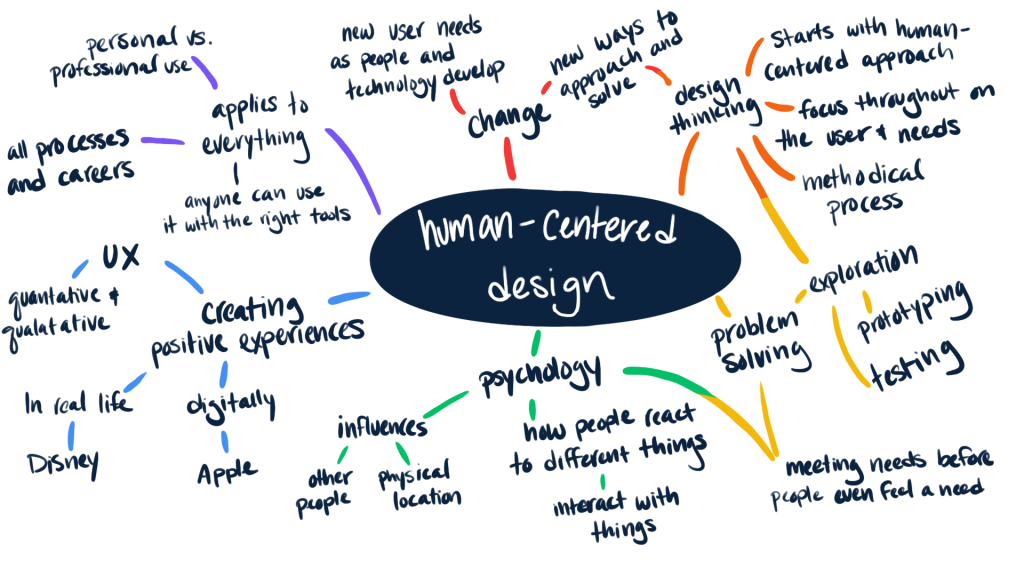
To begin planning my podcast, I made this mind map about user-centered design and complete a pre-production exercise outlining it in more detail.
 Victoria Lorenz