Overview
In this module, I learned about lighting and shooting and researched mini-documentaries. I focused on what makes a documentary impactful and how they evoke emotion. I also planned out my own mini-documentary and took preparatory steps for shooting.
Reading and Writing
Chapter 7 Lighting – The Bare Bones Camera Course for Film and Video By Tom Schroeppel
Subjects often look best when the sun hits them at a 45º angle. When the sun is directly above them, it casts harsh and unappealing shadows. It is often best to have the sun shining on the subject’s face because when it is on their side or behind them, it can cast harsh shadows, like when it is directly above.
Shadows can be filled in with reflectors and fill lights. Reflectors are usually a board covered with silver foil or paint that reflects light onto the subject. Fill light is any source of light that is daylight colored. The light can either be 5400K or 3200-tungsten with a filter on top to convert it to 5400K. Reflectors are helpful because they don’t require electricity and will always match the daylight. Fill lights are beneficial because they don’t depend on the sun and have more flexibility in the angle they can be used at.
The three primary kinds of interior lights are focusing quartz, broads, and softlights. Focusing quartz is similar to a spotlight and is the most common and versatile. It ranges from a spot, which focuses on one area, to a flood, which is a less intense area. Focusing quartz can still be extreme at full flood, so you may need to diffuse it to get the desired effect. Broads are used to cast even light on a large area and have no fine-tuning controls. Softlights are portable and have a broad-type light surrounded by a white or silver scoop. Softlights are highly convenient because they are easier to transport and control but take up a lot of space. Most lights, regardless of type, come with barn doors that block light from shining in unwanted areas.
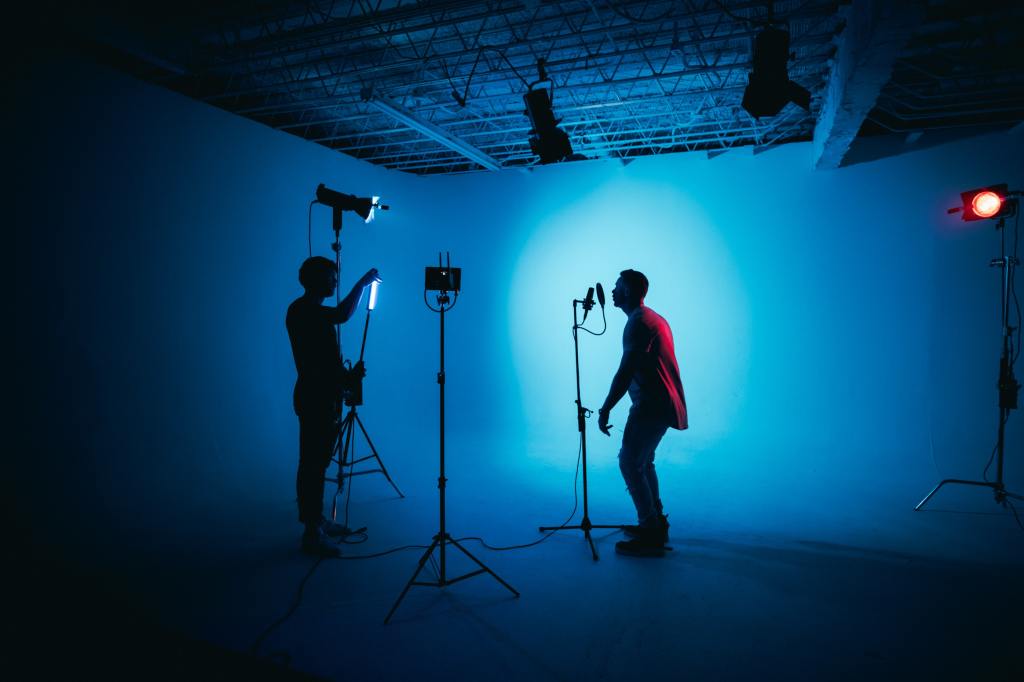
The key light, or main light, goes next to the camera roughly 45º above the subject. A fill light goes on the opposite side of the subject to fill in any shadows cast by the key light while adding depth. Next, the backlight goes behind the subject, lighting their head and shoulders and visually separating them from the background. Finally, the background light brings the background to a similar level of illumination as the rest of the scene.
Keep lights high and subjects away from walls to avoid unnatural or harsh shadows in the frame. Entire scenes can be lit with bounce lights because they are quick and effective and often look natural.
Chapter 9 Doing It – The Bare Bones Camera Course for Film and Video By Tom Schroeppel
Before shooting, you should determine the basics, such as what story you want to tell, who the audience is, and what you want to emphasize. Keep this information in mind as you consider the location and make a shooting plan. Shoot short sequences all the way through in a wide shot, then go back and shoot through in a medium shot, then a close-up, and then do cutaways.
With more practice, you can shoot small sections as medium and close-up shots and will need to use slates to identify the scene. A slate can be a piece of paper or a clapboard, but it must include the scene number and description. Slates make the editing process go faster and force you to think about how scenes will fit together while you’re shooting.
A shooting script is a list of what you’re going to shoot and often makes the process go faster and smoother. Storyboards help visualize what the scenes will look like.
Shooting out of sequence can also help save time if you have shots that occur at different times in the piece but use the same angle. Slates are helpful when shooting out of sequence so you can quickly identify which shot is which scene.
Finally, make sure to communicate with everyone you’re working with. Everyone should have the same goal, which makes things easier. Be sure to establish who is in charge to keep everything and everyone in order. Even in uncontrolled situations, you can use the principles of good composition to have successful footage.
Research to Inform
Good Dinner
This 5-minute documentary does an excellent job of telling a story and evoking emotion. It begins with eerie music and a dark shot of the subways that draws you in and makes you wonder what is happening. It soon reveals the story of a Chinese restaurant that is closing after 34 years. It is effective because we hear from the owner, employees, and regular customers who are all sad that the location is closing. Each person tells their unique story and relationship to the restaurant, which makes the viewer sympathetic to its closing.
One Minute Documentary
This one-minute documentary tells the story of a street performer who plays the violin. The audience is immediately drawn in by the violin music and the conversational quality of the performer’s story. The varying shots keep it interesting while we listen to the background story of the violinist.
All the Same Mini-Documentary
This two-minute documentary has a very professional and commercial quality but still draws in the audience and evokes emotion. It does so by interviewing four people with disabilities and getting their genuine points of view on web accessibility. The music in this piece is very fitting and enhances the sense of taking a critical look at a problem that needs to be better addressed.
Create
I completed a pre-producing planning worksheet for this part of the module to begin planning my mini-documentary. I also shot some footage to test out framing options and began preparing the location by getting out Christmas decorations and cleaning up the areas where I wanted to shoot.
 Victoria Lorenz