
Freelisting is a user experience research method that allows UX designers to collect data about users’ needs, desires, and opinions. “Freelisting is when a person is asked to list as much information as possible in order to gain a better understanding of a user’s mental model” (Pannafino 48). Freelisting is a qualitative research method that can yield quantitative results once cleaned and analyzed. Freelisting is beneficial when identifying patterns and themes among users to inform design decisions.
Benefits of Freelisting
The main advantage of freelisting is that it is a relatively quick, easy, and inexpensive research method that can be conducted with many participants. Some researchers have used this method at conferences to get feedback from hundreds of people. Chauncey Wilson explains that UX designers can “just hand out a sheet of paper, ask the freelisting question, and then collect the results.” It is an effective way to gather rich, detailed data on users’ attitudes and preferences.

Gaining insight into the user’s mental model is vital in UX research. Susan Weinschenk from UX Magazine explains that ” in the field of user interface design, a mental model refers to the representation of something – the real world, a device, software, etc. – that the user has in mind.” When products don’t match the user’s mental model, they can be frustrating and challenging to learn or use. Freelisting is a way for the user to lay out their mental model for us and, when completed on a large scale, can map out the overarching and most important trends among the target audience.
How to Use It
The first step in conducting a freelisting study is to identify the topic or concept that will be the focus of the research. This topic could be a specific product, service, or feature, or a more general matter related to user needs or preferences. Once the team identifies the subject, participants are asked to list as many items as they can that are associated with the topic.
Users can work independently or as a group. If freelisting is used in focus groups, researchers may want participants to work independently at first and as a group after the initial freelisting exercise. Working independently at first lowers the risk of groupthink and evaluation apprehension. In Understanding Your Users: A Practical Guide to User Research Methods, Baxter defines groupthink as “the tendency for the various members of a group to try to achieve group consensus. The need for agreement takes priority over the motivation to obtain accurate knowledge to make appropriate decisions.” Evaluation apprehension is similar; it is “the fear of being evaluated by others.” While this fear may cause users to hold back in the group setting, we can still collect accurate data from their independent freelisting responses at the end of the session.
The data collected from the freelisting study can be analyzed in several ways. One common approach is to use the data to create a list of the most commonly mentioned items, themes, and patterns, which can then be used to inform the design. For example, suppose many participants mention the importance of battery life in a mobile phone. This feedback will alert UX designers to prioritize the development of longer-lasting batteries in future mobile phone designs. If users frequently mention a particular feature or function that is not currently available in existing products or services, UX designers can identify new opportunities for innovation and product development.
Drawbacks
One limitation of freelisting is that it can be challenging to interpret the data. Because participants are free to list any item they like, the data can vary and may not always be easy to categorize or analyze. In addition, because the initial data is qualitative, it can be hard to draw quantitative conclusions.
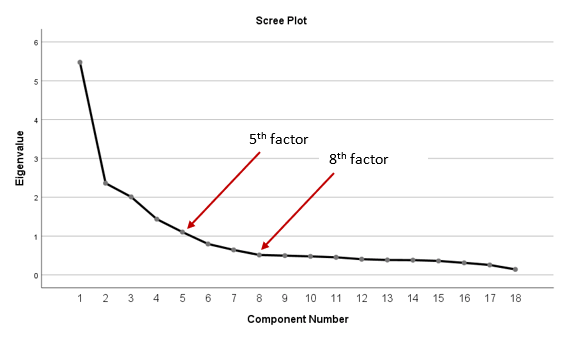
The CDC recommends using Anthropac software to create scree plots to analyze data from freelisting research. “Anthropac combines all respondent’s lists into a composite list and provides a salience index for every item on the composite list.” Salience measures how list items rank, allowing us to understand what stands out most to the user and where our focus is needed.
Another limitation of freelisting is that it may not always provide a complete picture of user needs and preferences. Participants may not always think of or mention all the essential features or functions they want to see in a product or service. As a result, it may be necessary to supplement the data collected from a freelisting study with data collected using other research methods, such as surveys or interviews.
Combining Research Methods
Several methodology variations can enhance the value of freelisting. For example, some researchers use card-sorting techniques to help participants organize and prioritize their lists of items. Others use mind mapping to help identify relationships and patterns in the data and ensure they’re developing an accurate understanding of the user’s mental model.
Conclusion
Overall, freelisting is a valuable research method for user experience design that can provide valuable insights into user needs and preferences. By carefully planning the study, selecting an appropriate sample of participants, and analyzing the data using proper techniques, designers and researchers can gain a deeper understanding of user needs and preferences and use this information to create more effective and engaging user experiences. While freelisting has its limitations, it can be a powerful tool for user experience research and design when used appropriately.
Sources
Baxter, Kathy, et al. Understanding Your Users: A Practical Guide to User Research Methods. 2nd ed., Morgan Kaufmann, Elsevier Ltd, 2015.
Chase, Roberta, and Steve Borgatti. “Anthropac.” Analytic Technologies, http://www.analytictech.com/anthropac/anthropac.htm.
Keddem, Shimrit, et al. “Practical Guidance for Studies Using Freelisting Interviews.” Centers for Disease Control and Prevention, 14 Jan. 2021, https://www.cdc.gov/pcd/issues/2021/20_0355.htm.
Pannafino, James, and Patrick McNeil. UX Methods a Quick Guide to User Experience Research Methods. CDUXP LLC, 2017.
Quinlan, Marsha B. “The Freelisting Method.” SpringerLink, Springer Singapore, 23 Dec. 2017, https://link.springer.com/referenceworkentry/10.1007/978-981-10-2779-6_12-2.
Spencer, Donna. “Design Games – Freelisting.” UX Mastery, 31 July 2014, https://uxmastery.com/design-games-freelisting/.
Weinschenk, Susan. “The Secret to Designing an Intuitive UX.” UX Magazine, 8 Oct. 2011, https://uxmag.com/articles/the-secret-to-designing-an-intuitive-user-experience.
Wilson, Chauncey. “Method 3 of 100: Freelisting.” Designing the User Experience at Autodesk, 13 Jan. 2011, https://dux.typepad.com/dux/2011/01/this-is-the-third-in-a-series-of-100-short-articles-about-ux-design-and-evaluation-methods-todays-method-is-called-freeli.html.
 Victoria Lorenz