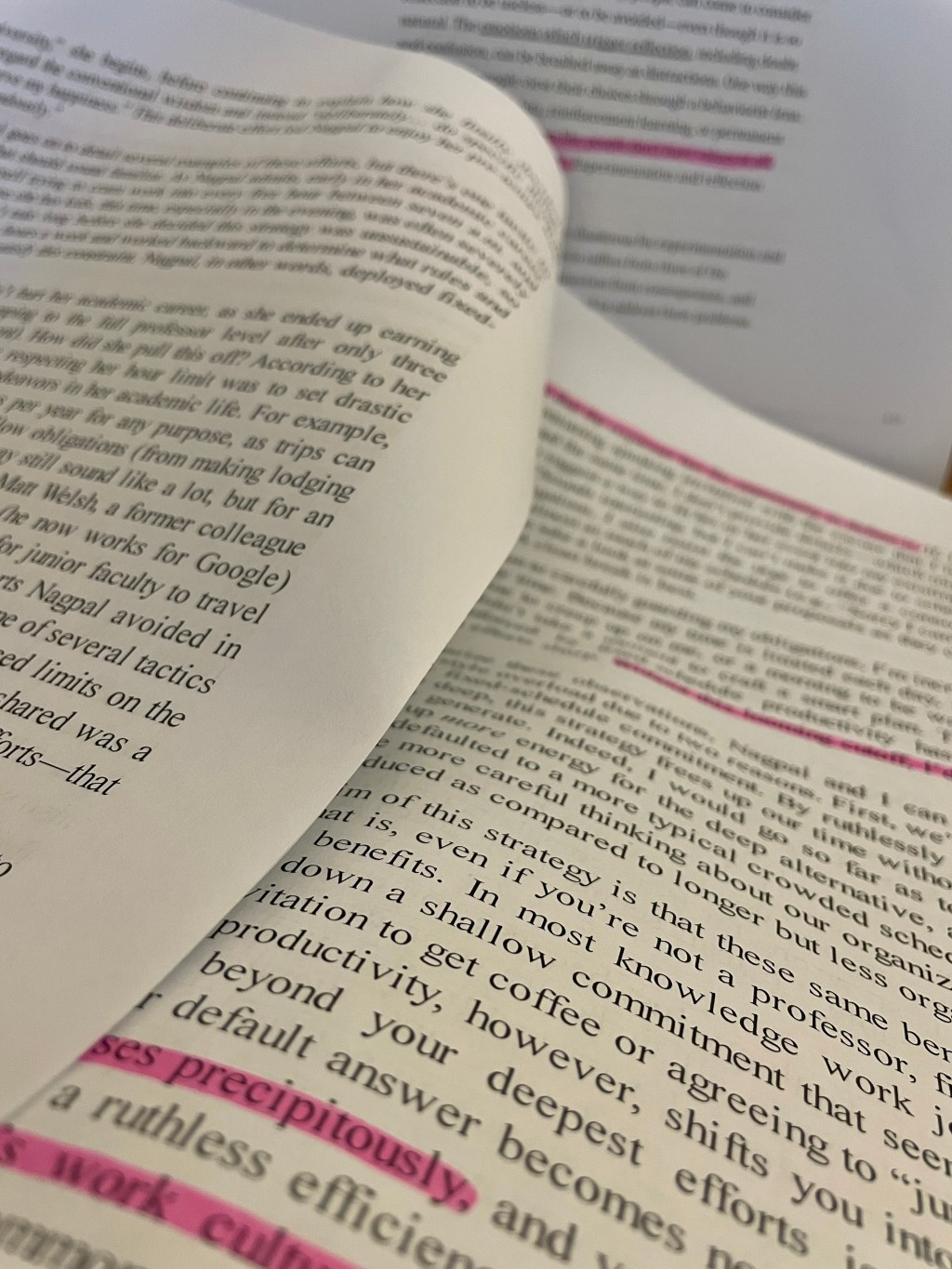
Deep work and design thinking are two very different processes with extraordinarily similar goals. Deep work aims to maximize your ability to think deeply and push your brain to the limits. Similarly, design thinking structures problem solving in a way that attempts to assess all possible solutions to a problem and then proceeded with the one that is most effective. Ideation in the design thinking process requires immense effort and understanding of the issue at hand from many different perspectives. Integrating these two approaches can lead to the development of ideas, systems, and methods that would otherwise be unattainable.
Deep work outlines two kinds of work: deep work and shallow work. Deep work is “professional activities performed in a state of distraction-free concentration that push your cognitive capabilities to their limit. These efforts create new value, improve your skill, and are hard to replicate.” Conversely, shallow work is “noncognitively demanding, logical-style tasks, often performed while distracted. These efforts tend not to create much new value in the world and are easy to replicate.” The design thinking process is composed of five steps: empathize, define, ideate, prototype, and test. These steps are nonlinear and should be revisited as often as necessary to ensure a comprehensive understanding of the problem at hand.
In the field of design, the effort necessary to produce such solutions takes a astounding amount of effort. This can lead to burnout which effects both individual designers and the greater community. Using deep work and design thinking together can both lessen stress and burnout while increasing productivity and effective designs.
Read the full paper below.
 Victoria Lorenz
One response to “Design Thinking and Deep Work”
[…] of subheads conducive to scanning from “Design Thinking and Deep Work: The Key to Solving Problems and Avoiding Burnout” by Victoria […]
LikeLike