
What is a POV Statement?
UX designers can’t exactly read minds, but they do the next best thing. They form point of view (POV) statements that break down a problem, making it meaningful and actionable. Rikke Dam and Teo Siang from Interaction Design Foundation explain that POV statements ensure designers target the right issue. POV statements also ensure that we are designing for a specific audience.
How to Write a POV Statement
POV statements have three major components: the user, their needs, and our insights. The user is the specific person we’re designing for. Their needs often are goals or actions they wish to complete. Perficient describes our insights as the key takeaway from the information we gathered. Insights are essential in developing and designing the solution.
POV statements most often follow the structure “users who (description) need (verb) because (insight). Although the wording can change, this basic format sets us up for success, ensuring we identify all three key points. At the end of this blog, you can see two examples of POV statements I wrote after doing some user experience research.
POV Statements in Practice
To practice writing POV statements, I first needed feedback from real users. One great (and free!) resource for this data is reviews of apps on the app store. To get a well-rounded sense of what users were experiencing, I looked for positive, negative, and suggestive reviews. It can take some time to sort through them all, but the insights are worth it.
Spotify
Overview
I selected Spotify as the subject for this exercise because I use the app regularly. While I mostly enjoy it, I also recognize that it has some flaws, so I wanted to get a glimpse into what other users are experiencing.

Spotify is an audio streaming app with music, podcasts, and recently added audiobooks. Listeners can access it via an app for mobile and desktop or with the web player on a desktop. There are free accounts and paid subscriptions costing $9.99 per month. Listeners can easily transfer their listening session across devices and connect with friends to see what they are listening to.
Primary Screens
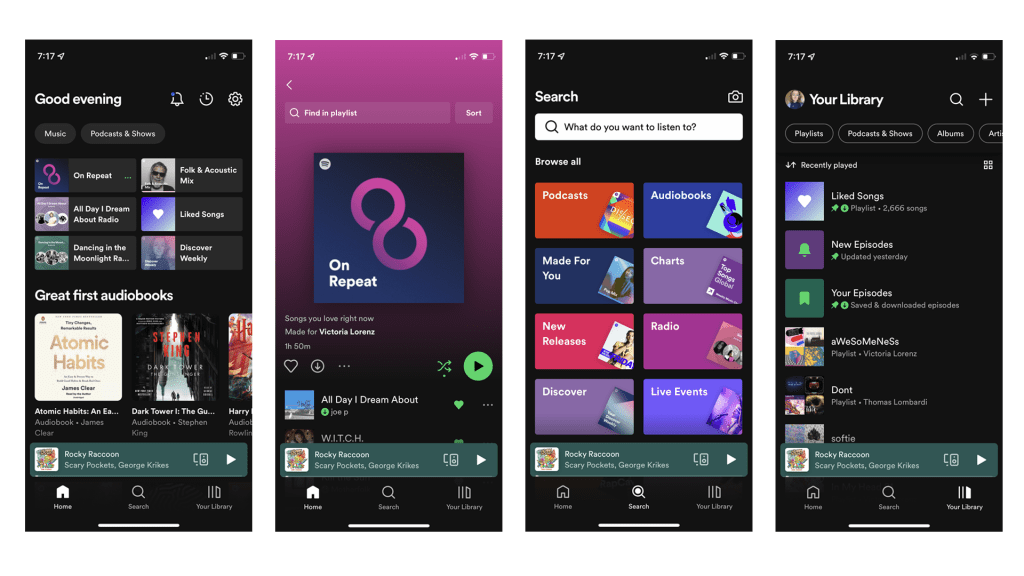
These are the primary screens for Spotify. When you open the app, you land on the home screen, which has your most recently listened to content for quick access and suggested content below. Next is the search feature, where you can search for individual tracks, albums, and playlists. The final screen in the navigation is ‘My Library,’ which contains a user’s playlists and podcasts. The last notable screen in the playlist. When users select a playlist, they see the cover image, title, description (if available), and the tracks it contains. If they did not make the playlist, they can ‘like’ it to save it.
Positive Reviews
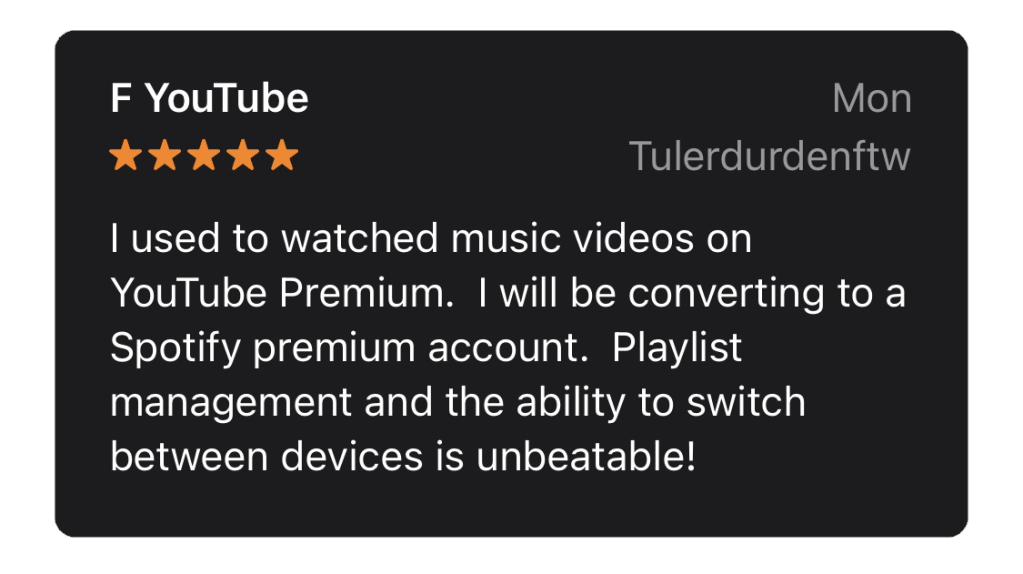
The first review is from a user who used to use YouTube Premium but switched to Spotify premium. This user likes how easy it is to transfer a listening session from one device to another. It is also worth noting that Spotify Premium is less expensive than YouTube premium.
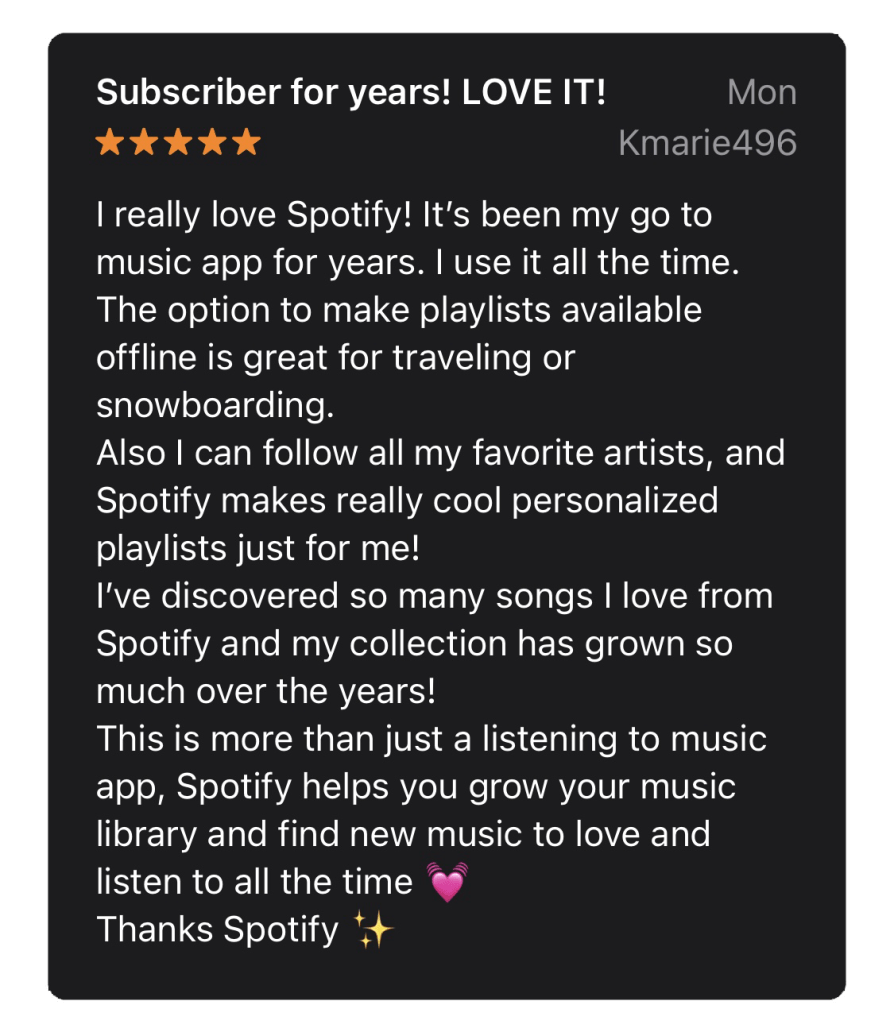
The next positive review is from a long-time user. They enjoy listening to music offline, the ability to follow artists, and custom playlists made by Spotify. This user explicitly states that Spotify is more than just a streaming app because it helps you discover new music and expand your taste.
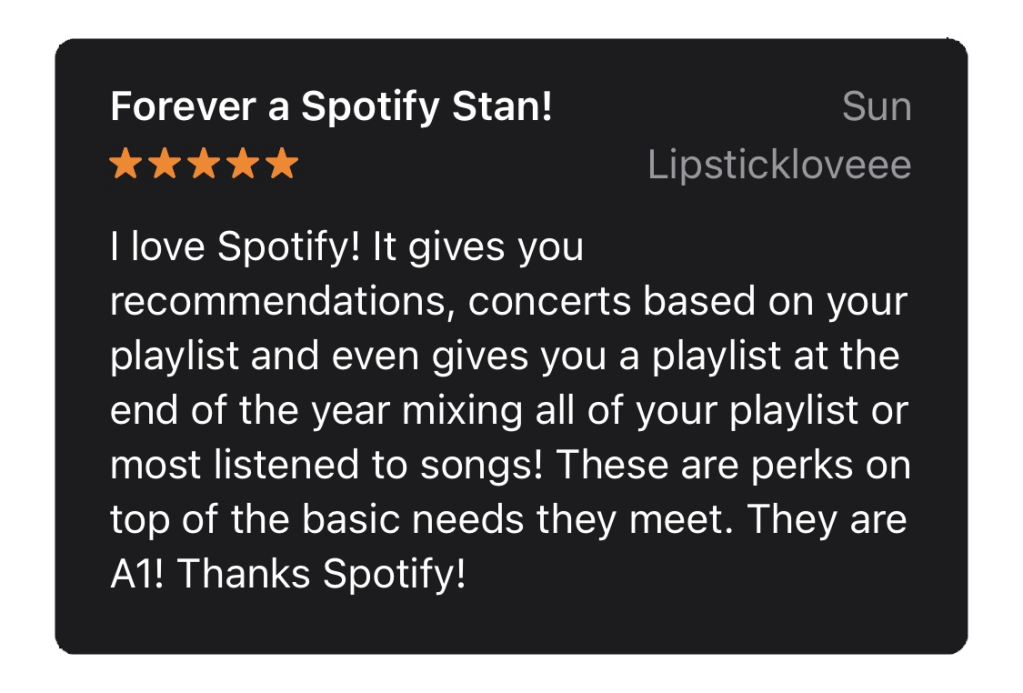
The third positive review comes from a user who enjoys the music recommendations, updates about local concerts for bands you listen to, and Spotify Wrapped. Spotify Wrapped is a yearly review of users’ listening habits, giving them insight into what they listened to the most and how they compare to other users. Features like this make this user feel like Spotify not only meets their basic needs but goes above and beyond.
Negative Reviews

The first review is from a user who has music available to stream on Spotify and is disappointed with the playlists it is automatically put into. They are also upset that they receive minimal money when other users stream their songs. This user believes that Spotify and similar platforms negatively affect the music industry.
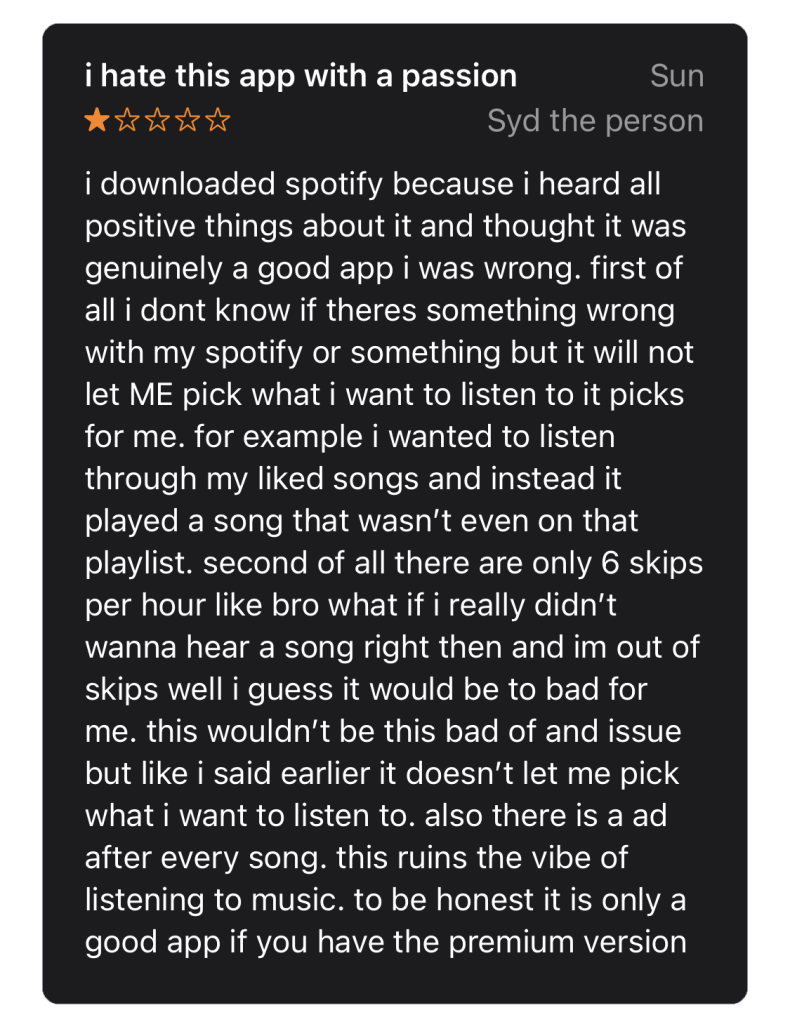
The next review is from a new user of Spotify who began using it because friends recommended it. They are frustrated with the free account because they cannot pick which songs they listen to and only get six skips per hour. This user feels that Spotify is only valuable if you have the premium version.
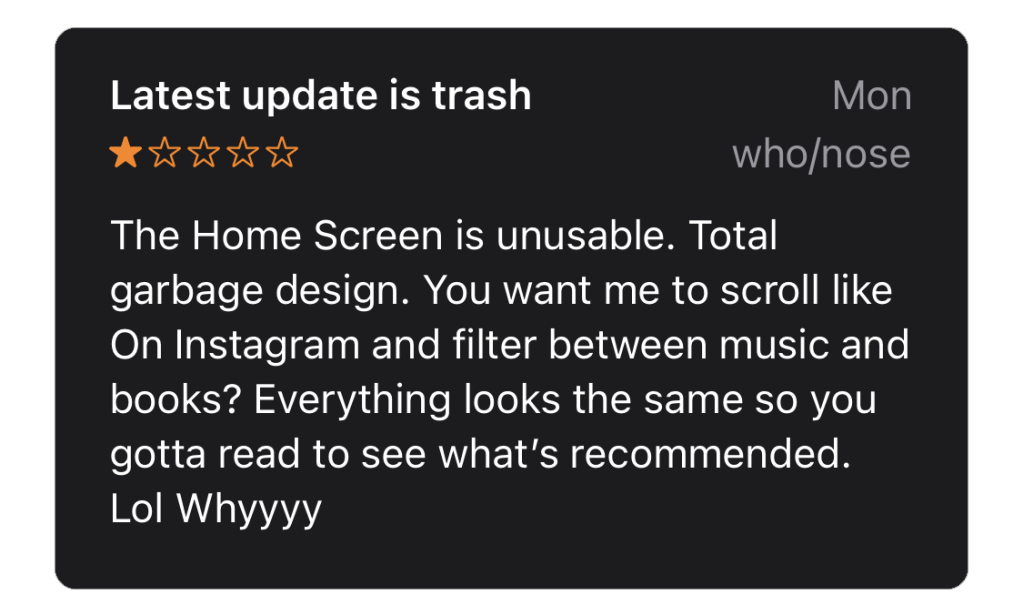
The third review focuses on the home screen. This user feels that it is unusable and frustrating. They do not like scrolling through all options because it feels too much like social media. Additionally, they have difficulty distinguishing between types of content, such as music and audiobooks.
Suggestive Reviews
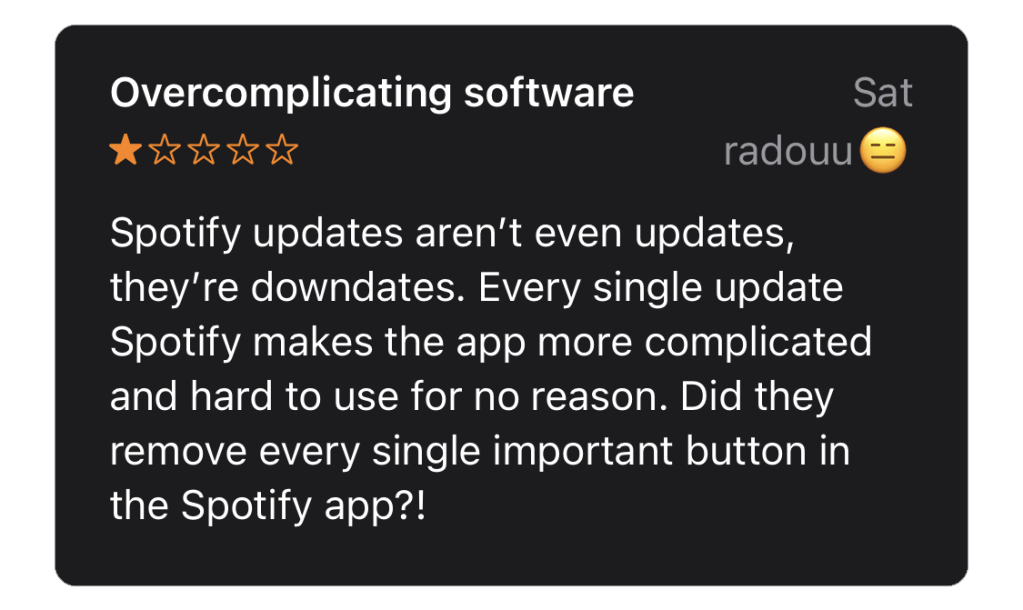
The first review is from a user who finds that Spotify updates make the app too complicated. They feel that all the important buttons are disappearing in favor of bells and whistles that take away from their experience.
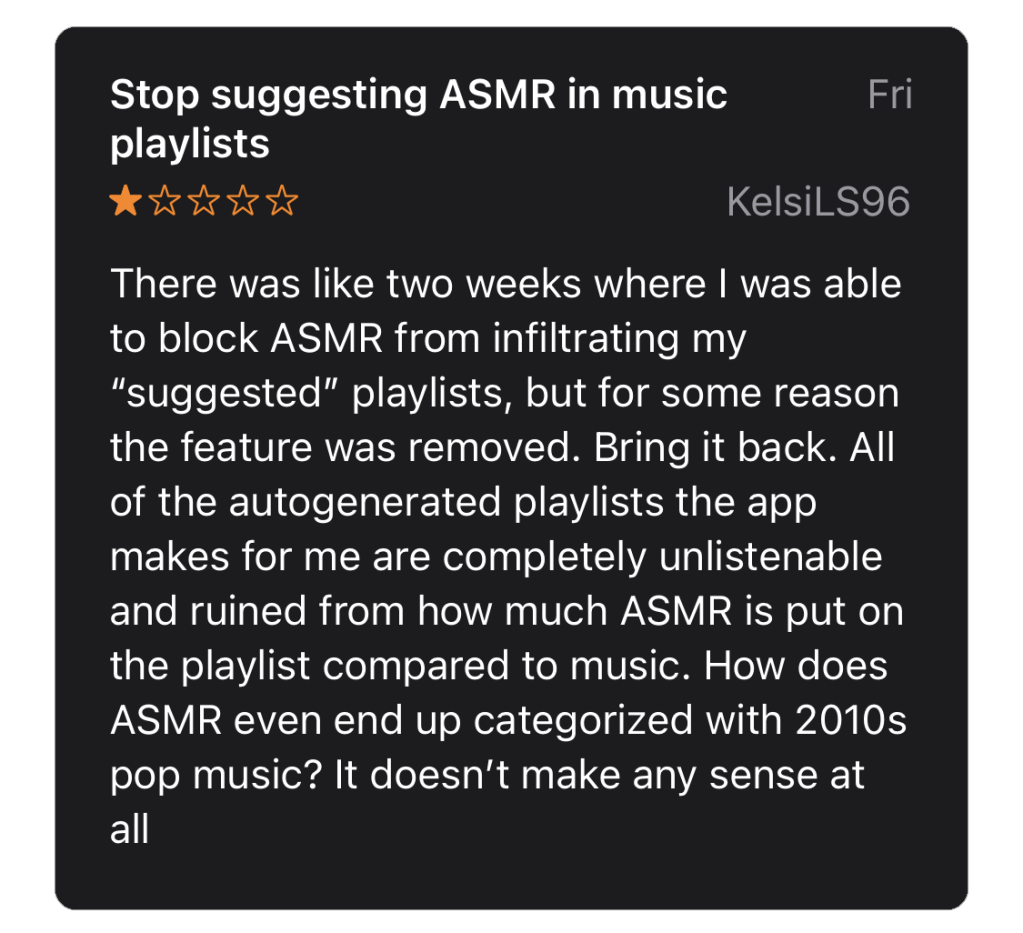
The next review is from a user who wants to remove a particular genre from their suggested playlists. This user has found ASMR is taking over their listening experience. ASMR, or autonomous sensory meridian response, is audio and video content that is known for giving listeners pleasant tingly feelings. Because ASMR isn’t music, this user wanted to filter it out of their suggested playlists but was unable to. This user was particularly frustrated because they briefly could make these adjustments before the feature vanished.
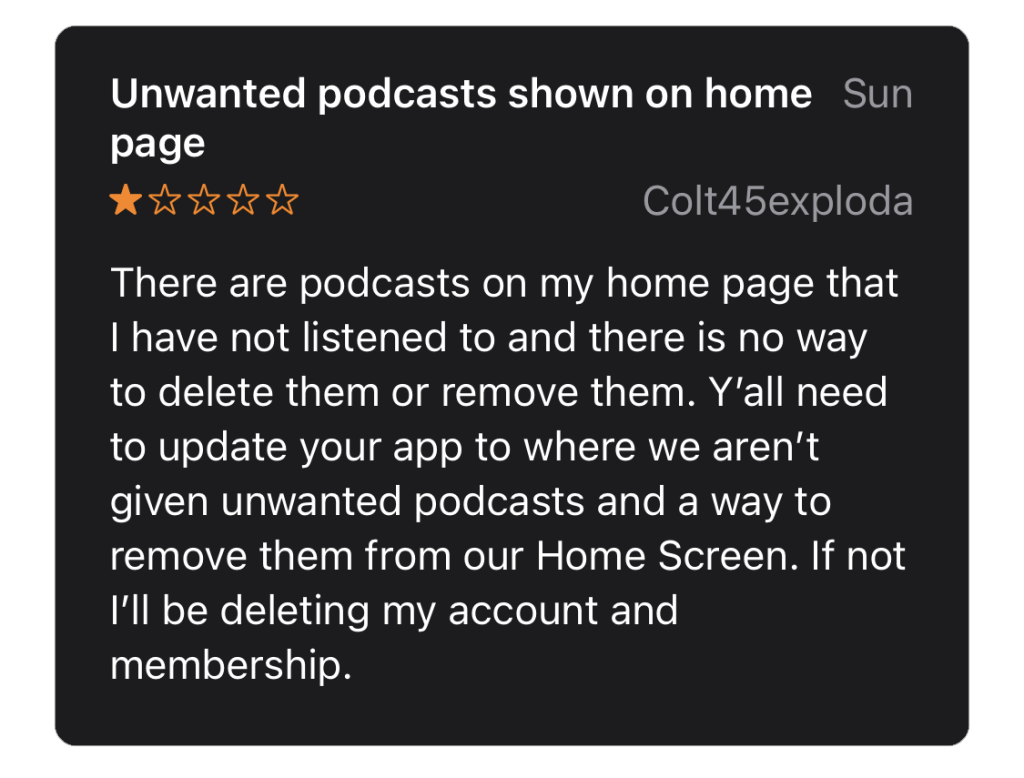
The third review focuses on the customizability of the home page. This user found content they weren’t interested in, such as podcasts, was regularly appearing on their homepage. Because the homepage is the first thing a user sees when they open the app, it is reasonable that they want only to see the content they like and want to engage with.
POV Statements
After reflecting on the reviews, I made two POV statements that each targeted a unique user with a unique need.
Statement 1
Users who do not have premium accounts need more control over their experience because the restriction of features like the order of songs and the ability to skip takes away from the inherently personal experience. Such limited control removes users from their experience, making it much less enjoyable.
Statement 2
Users who enjoy discovering new music need more control in the algorithm because their specific interests, which are not reflected in listening data, are not accounted for. Users may want to see more or less of one particular genre in the playlists generated for them and should be able to influence those playlists accordingly. Many of these preferences are not reflected in users’ listening data, so another method should be available.
 Victoria Lorenz
One response to “Learn to Read Minds Like a UX Designer”
[…] addressing who the user is, what they need, and why. You can read more details in my article Learn to Read Minds like a UX Designer. POV statements pinpoint problems, so they’re the perfect focal point to apply ideation […]
LikeLike